Puzzle games: less guessing, more solving.
Choose Sudoku or Nonogram for deduction, 2048 for managing space, and Minesweeper for reading neighboring clues. Start with one rule or habit to practice, then use the game’s controls and guide to check what changed.
Choose the problem you enjoy
Pick a puzzle by the kind of information it hands you. Sudoku and Nonogram hide a fixed answer, Minesweeper reveals clues only as you open squares, and 2048 changes the board after every move.
| Game | Is the answer fixed? | What a move does |
|---|---|---|
| Sudoku | Yes | Proves one digit from its row, column and box |
| Nonogram | Yes | Fills or crosses a square the clues force |
| Minesweeper | Yes, but hidden | Opens a square and gathers new information |
| 2048 | No | Slides every tile, then adds a new random tile |
Where the uncertainty lives
Sudoku and Nonogram hide a fixed answer that your deductions uncover. Minesweeper hides one too, but it shows clues only around squares you have already opened. 2048 hides nothing and instead changes the board after every move you make.
Match your goal to the right-hand column. Prove a fact in Sudoku, gather information in Minesweeper, and keep space in 2048.
Match the game to your break
Match the game to how long you can stay. An untimed decision waits for you; a board that changes after every move does not.
- Sudoku: a candidate can sit unfinished while you think or step away.
- 2048: finish the move and look at the new tile before deciding whether to carry on.
- Nonogram: a five-cell row can be completely determined, or need evidence from its columns first.
- Minesweeper: a frontier can stay uncertain even after every available deduction.
Neither a small grid nor a simple rule promises a short solution.
Understand the information before acting
Work out which squares must be true in every valid arrangement before you fill anything in.
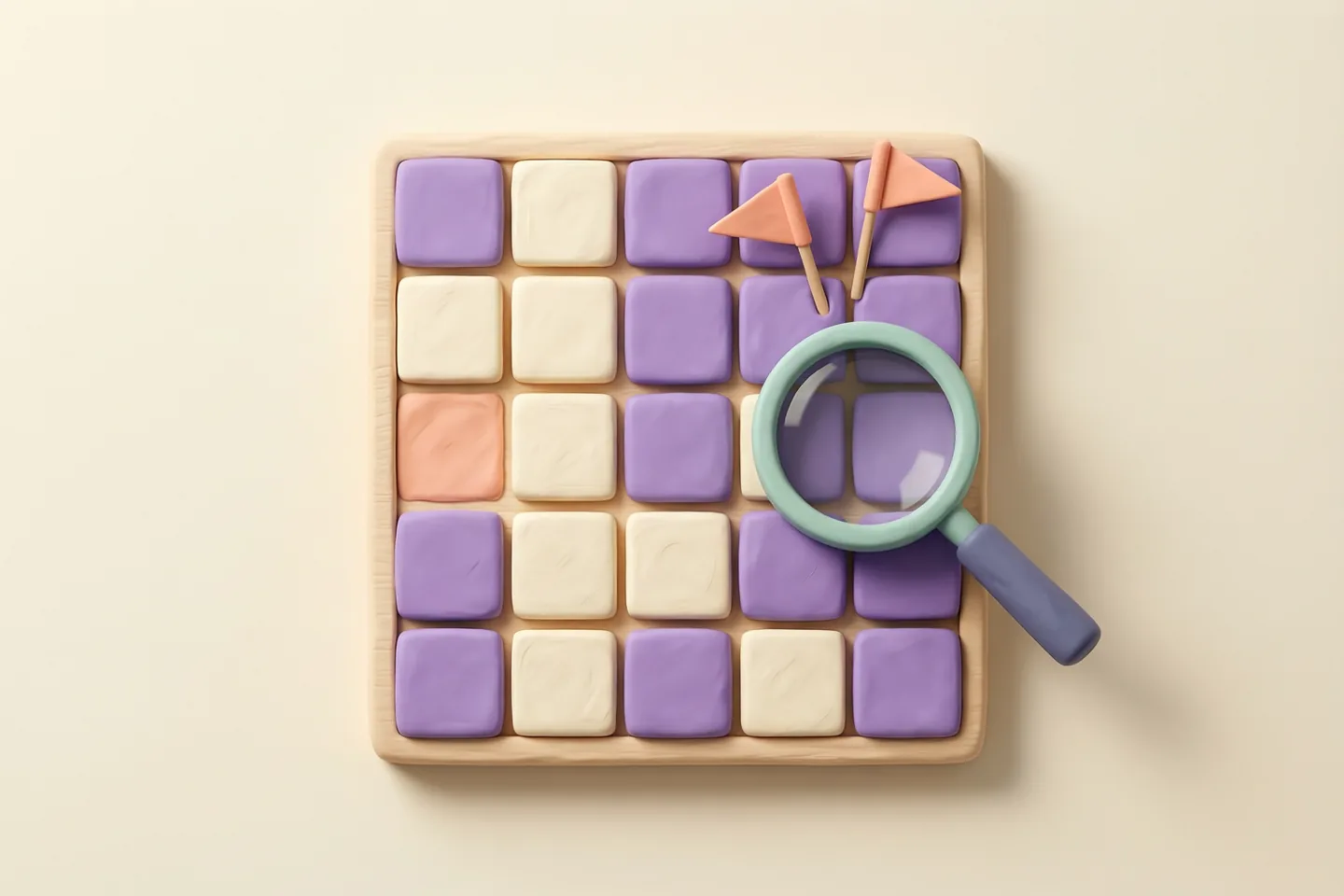
Forced squares in a Nonogram
A clue of 2 2 fills a five-cell line exactly: two filled, one empty, two filled. There is no spare space, so every position is fixed. A clue of 3 leaves three placements, and only the middle cell is shared by all three.
A flag is a conclusion, not a fact
Minesweeper works the same way. A flag records what you decided, not what the board holds. If two mine arrangements both fit the clues, neither square is proved.
Ask which cells agree across every valid arrangement. That one question works in both games.
Use 2048 undo to review a decision
Undo in 2048 restores the tiles and the score from your last successful move, so you can compare two positions instead of guessing.
- Make the move, then press Undo to return to the earlier board.
- Check whether a small tile now sits between two equal larger tiles.
- Check whether your largest tile stayed on its edge.
- Count the empty cells in each version.
What the score does not tell you
Two boards with the same score can be in very different shape. Compare the position of the largest tile and the number of empty cells instead. Those two numbers describe how much room you still have to recover.
You can reverse one move. Another undo becomes available after a new successful move, and an input that moves nothing does not add a tile.
Practice a small, observable goal
Set a goal you can check in a single move, and decide first whether you are testing an unknown answer or rearranging a known one.
Testing an unknown answer
In Mastermind a guess can be useful without being close. A result of no matches removes every colour you guessed from consideration, which is real progress.
Rearranging a known target
In Fifteen Puzzle you can already see the finished picture, and the blank square decides which tiles can move at all. In Lights Out your press changes the puzzle itself, and pressing the same cell twice restores the original lights.
Name the type before you judge the attempt
Treat a failed Mastermind guess as evidence and a failed Fifteen Puzzle sequence as a position to undo. The same disappointment means different things in the two games. Naming the type first stops you calling useful work wasted.
A failed attempt of the first kind is information. A failed attempt of the second kind is a position you can usually undo.
Use a lesson that matches the rule
Use the lesson written for the rule you are stuck on, because a pattern from one puzzle rarely transfers to another.
| Game | The question that helps |
|---|---|
| Sudoku | Which digits do this cell’s row, column and box still allow? |
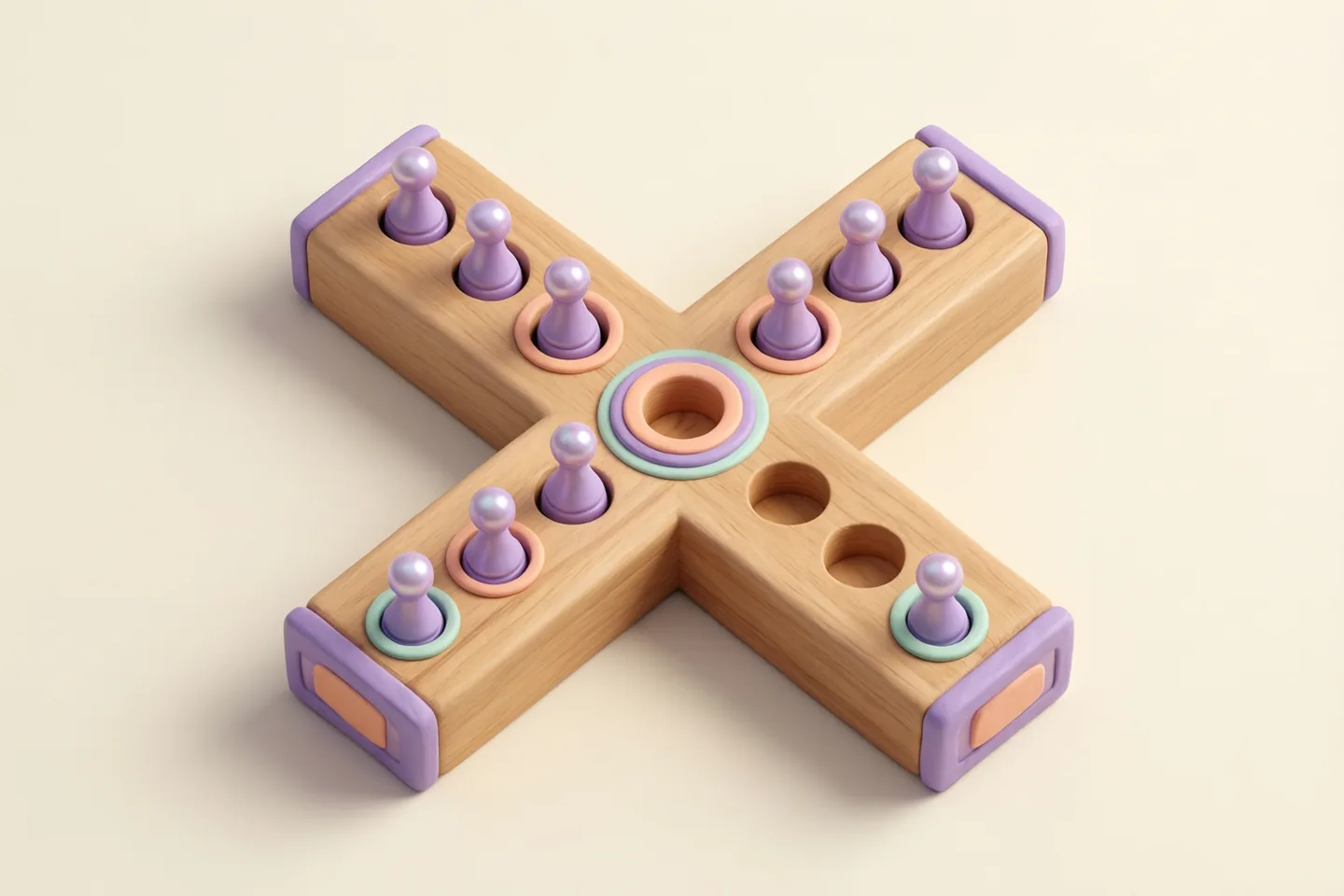
| Peg Solitaire | Which three holes in a line hold two pegs and one gap? |
| Minesweeper | Which covered squares do two clues share? |
| Hangman | Which unused letter separates the words still possible? |
The linked game pages show their controls, and each lesson works through the deduction that belongs to its own rules.
Choose between pair matching and merging
In Butterfly Kyodai, equal tiles need a path with at most two turns between them. In 3D Mahjong Tower, the path is irrelevant: each matching tile needs an open side and nothing above it. Make 7 asks a third question. Three touching equal numbers combine into one higher number, and that new tile remains at the last placement. Read the connection rule before assuming that matching faces are enough.
Compare the information available in a card deal
FreeCell shows every card and gives you four temporary cells, so moving a run depends on how much working space remains. Spider Solitaire hides cards beneath its tableau and lets you move only ordered same-suit runs together. The 13 in 1 Solitaire Collection puts these differences into a selector: Russian permits unordered groups, while Baker’s Dozen moves only one card and never refills an empty column. Use the rule panel before carrying a habit from one variant to another.
Separate movement from geometry
Basket Slide sends both the ball and basket toward a wall with one swipe. A useful move may stop the two pieces at different distances before their next shared slide. Tangrams gives you independent control of seven pieces and checks the area they cover. Unfold reflects an entire connected region. For these puzzles, sketch the result of the move before making it; an empty destination alone does not guarantee that the whole shape fits.
Pick the word task you want
Word Search is about finding a supplied word hidden in a letter grid; its Puzzle selector offers a random board or a Daily one seeded from the UTC date. Word Farm asks you to solve clues and fit their answers into crossing slots. Wording uses a central required letter and a finite accepted-word list. Uniwords adds a movement puzzle: the meteor must reach letters in spelling order while a planet bends its path. The amount of vocabulary and the kind of control differ between these games.
Try the distinction on a real board
Open Sudoku for a playable example from this collection, then continue with the arcade game guide. Browse the puzzle games collection as more games are added to the public library.
Questions about puzzle games
Which puzzle games here have exactly one right answer?
Sudoku, Nonogram and Minesweeper each hide a single fixed answer, and the site generates every Sudoku and Nonogram board with exactly one solution. 2048 is different, because a random tile appears after each successful move, so no fixed answer exists. Pick a fixed-answer puzzle when you want to prove something, and 2048 when you want to manage a changing board.
What should I do when a puzzle stops giving me moves?
Rescan the rows, columns or clues that your last entry changed, because a new fact usually unlocks the next step. If nothing appears, look for a square that two separate clues both describe. Guessing to keep the board moving costs more time than a pause does, since a wrong entry poisons every deduction after it.
Do puzzle skills carry over from one game to another?
The habit of checking before acting carries over, but the specific patterns rarely do. A Minesweeper overlap argument says nothing about a Sudoku box, and a 2048 corner plan is useless in a Nonogram. Learn the deduction that belongs to each rule set rather than expecting one trick to work everywhere.
Is using Check, Hint or Undo cheating?
No. These buttons are part of the games and they behave differently, so use them knowing what each one gives you. The Sudoku Check button highlights digits that clash with a row, column or box, the Nonogram Hint reveals one square straight from the solution, and 2048 Undo restores your last move. Only the Hint hands you an answer you did not work out.
What should I do after I notice a mistake halfway through a puzzle?
Undo it if the game offers Undo, because an early wrong mark makes later deductions look valid when they are not. Nonogram and the sliding puzzles keep an Undo button, while Sudoku lets you erase a digit you entered. If you cannot tell how far the damage spread, starting a new board is faster than untangling a poisoned grid.
These tips refer to the editions in our library. Game controls and behavior can differ elsewhere. Spotted a problem?