Pipe ManiaPuzzle·Free to play
 Free-Games.toSign inSurprise me
Jump and remove pegs from an English cross board until only one remains.
Sign in to save your scores and play history, or keep playing as a guest. Recent game activity and scores appear on the homepage with a masked email or IP address.
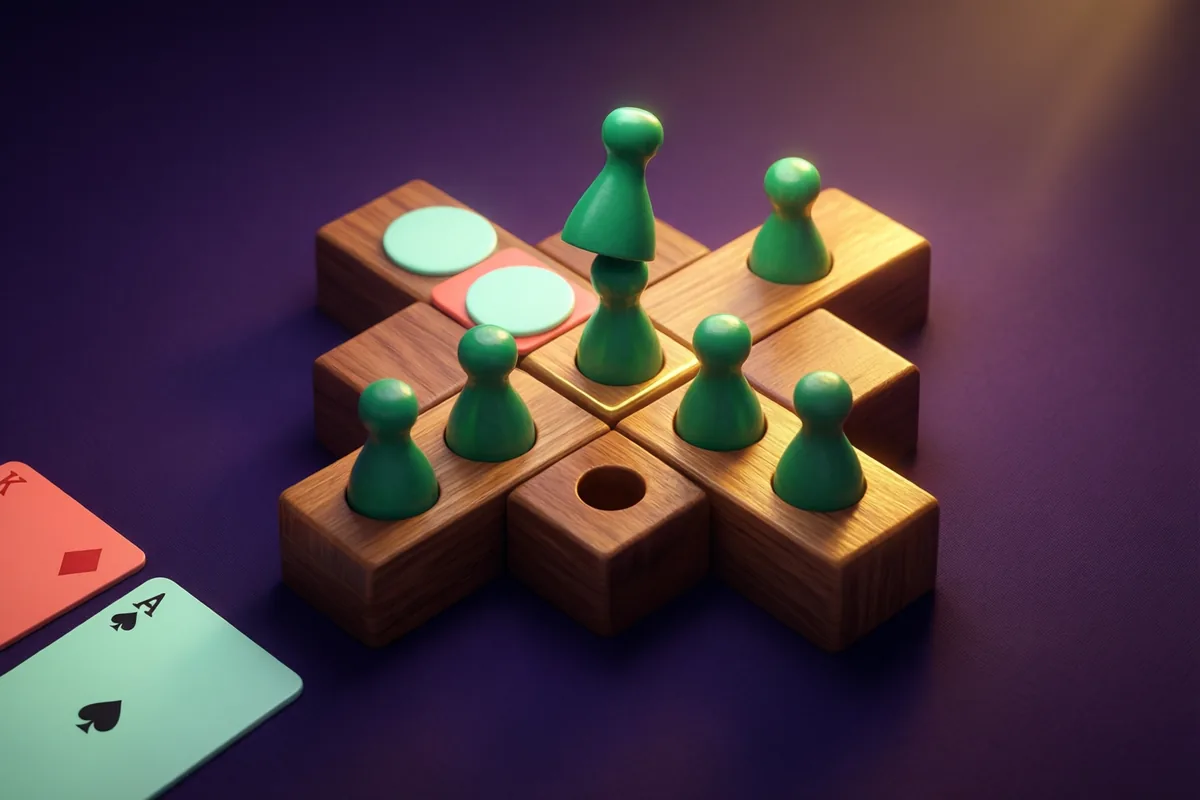 Peg Solitaire
Select a peg, then a marked hole: jump and remove a peg · Arrow keys / Enter: navigate and select holes · Undo: reverse the last jump
The cross has 33 holes and 32 pegs. The center hole begins empty. The starting arrangement is the same each game.
Select a peg, then jump horizontally or vertically over an adjacent peg into the empty hole immediately beyond it. The jumped peg is removed. Diagonal jumps are not allowed.
Finish with a single peg anywhere to win; ending in the center is an extra challenge. If no legal jumps remain, use Undo to explore a different route.
This Peg Solitaire game is built for Free Games. Read about controls and local storage.
An empty hole helps only when a neighboring pair can use it. Bloxorz offers another route-planning puzzle, with the block’s orientation determining which floor tiles it occupies.
If a legal jump leaves a peg stranded, the Peg Solitaire jump guide explains how to inspect connections and use Undo to compare another continuation.
Peg Solitaire is a game of subtraction. The English board is a cross of 33 holes, a 7 by 7 grid with the four corner blocks removed. Every hole starts with a peg except the middle one, so you begin with 32 pegs and one gap.
A move is a jump. Pick a peg, hop it horizontally or vertically over an adjacent peg into the empty hole directly beyond, and remove the peg you jumped. Diagonal jumps do not exist on this board. Each jump takes one peg off, so a complete game is exactly 31 jumps. Leave one peg and you have solved it. Leave one peg in the centre hole and you have solved it properly, which is the classic challenge.
The danger is stranding pegs. A peg in a far arm with nothing to jump and nothing to jump it is dead weight, and boards regularly end with six pegs scattered too widely to reach each other. Keep your pegs in clumps and think about which one will make the final jump. Undo backs out of a sequence, so treat it as a study tool. The Peg Solitaire rules guide shows the standard opening moves, and Lights Out scratches a similar itch.
| Genre | Puzzle Games |
|---|---|
| Challenge | Hard to finish, easy to strand yourself |
| Pace | Five to twenty minutes per attempt |
| Original era | 1697, at the French court |
| Players | Single player |
| Controls | Select a peg, then a marked hole, Arrow keys / Enter, Undo |
| Cost | Free, with no account and no download |
The first solid evidence is an engraving from 1697 of Anne de Rohan-Chabot, Princess of Soubise, with a solitaire board, and a note in the Mercure galant of 1697 describing the game as new. A popular story says it was invented by a French nobleman imprisoned in the Bastille, but that tale first appears much later and has no supporting evidence, so treat it as folklore.
Two board shapes became standard. The English board has 33 holes in a cross with arms three holes wide. The European or French board adds four more holes at the inner corners, making 37. That small difference matters a great deal: on the French board, the classic central game cannot be finished with one peg at all, which was proved using an argument about colouring the holes in three classes.
The mathematician John Conway and colleagues studied the game in the 1960s, developing the pagoda function that proves certain positions are impossible. Ernest Bergholt found a 18-move solution to the central problem in 1912, later proved to be the shortest. The puzzle collection holds more single-player boards.
Thirty-two, in a cross of 33 holes with the centre hole left empty. Because each jump removes exactly one peg, a perfect game is 31 jumps long and ends with a single peg standing.
No. On the English cross board, jumps run only up, down, left and right. The peg you jump must be immediately adjacent and the hole beyond it must be empty. Diagonal jumps belong to the triangular version of the game.
One peg left anywhere on the board. Finishing with that last peg in the centre hole is the traditional and much harder goal, and it is the one most solvers aim for once they have managed a single peg at all.
Because pegs drifted apart. A jump needs three holes in a line: your peg, a neighbour to jump, and an empty hole beyond. Pegs in different arms of the cross with gaps between them can never satisfy that, so keep them clustered.
Yes. Unlike a shuffled puzzle, Peg Solitaire always begins with the same full cross and the same empty centre. That is what makes it a problem to be solved rather than a round to be replayed, and why memorised openings work.
Backing out of a line of play. When you reach a dead end with six pegs scattered, Undo lets you rewind jump by jump and try a different branch instead of clearing the whole board and starting again.
From the standard centre-empty start on the English board, yes, and there are many solutions. Change the starting hole and it is not guaranteed. On the French board the centre-to-centre game is provably impossible.
Four games from the same shelf, each with its own pace. The one-line summaries are how their own pages describe them.
| Game | What it is like | Pace | Play |
|---|---|---|---|
| Pipe Mania | The goo is coming. Your plumbing isn't ready. | Shorter countdowns, faster goo | Play |
| Bloxorz | A block with two states and one destination. | Patient - Until the edge | Play |
| Line Rider | You draw the mountain. Gravity does the rest. | Draw calmly, watch helplessly | Play |
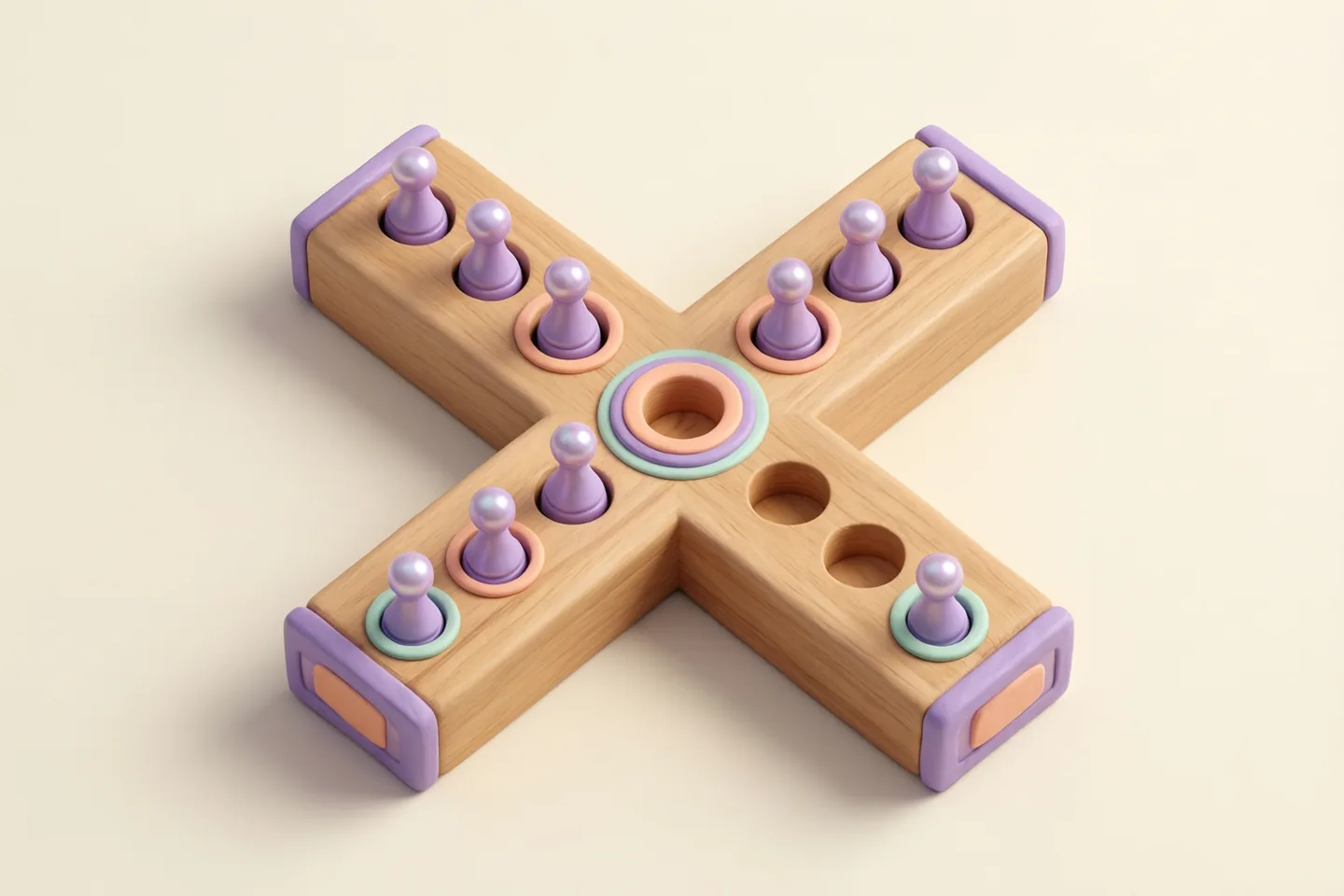
Read the cross as a network of possible jumps, not separate pegs.
Shortcuts