15 Puzzle, Lights Out and Mastermind: three ways to reason.
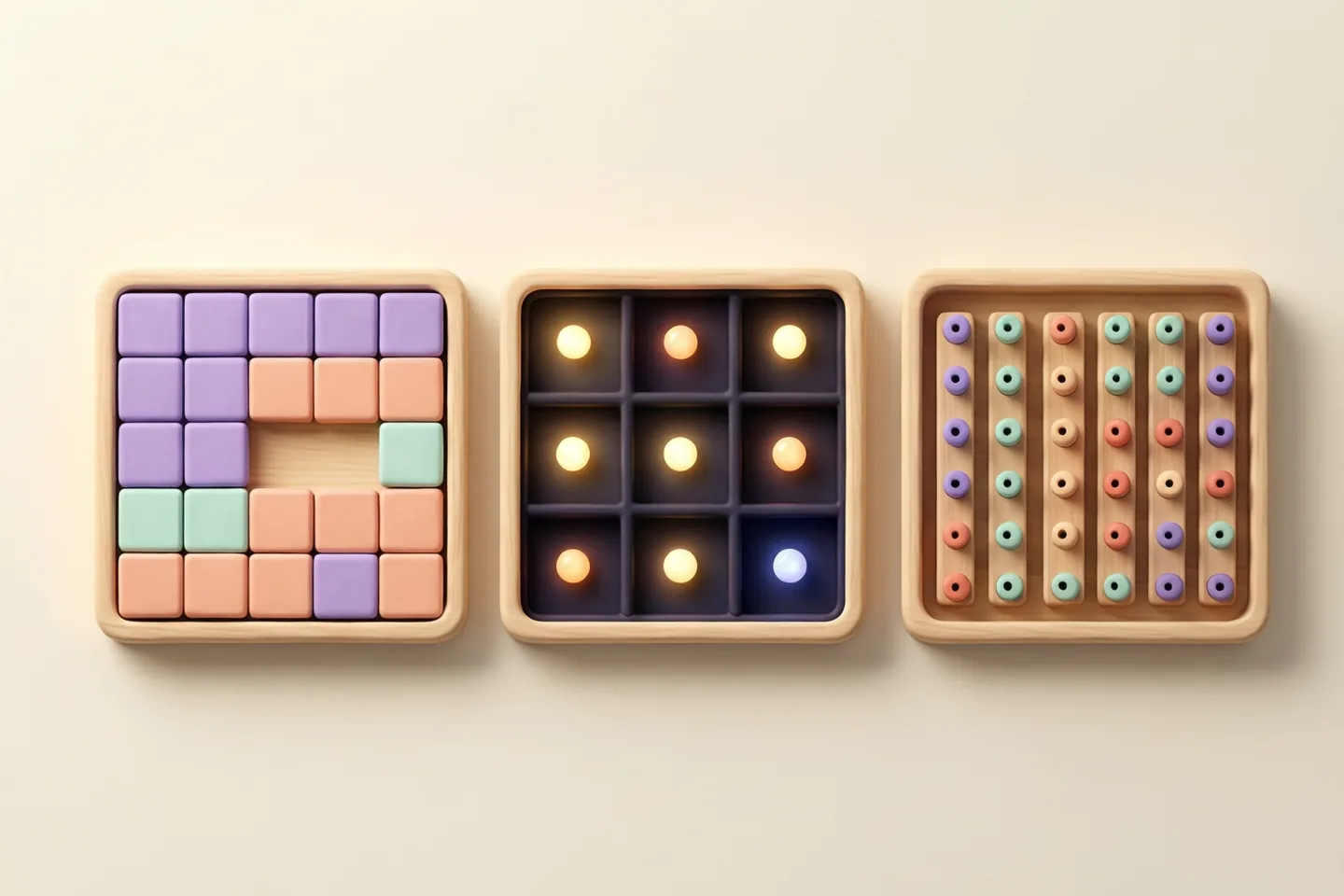
Fifteen Puzzle moves a tile into an adjacent gap; Lights Out toggles a cell and its orthogonal neighbors; Mastermind compares four-peg guesses with exact-position and color-only counts. Each rewards a different kind of deduction.
Fifteen Puzzle: protect the part you have solved
In 15 Puzzle, only a tile beside the empty square can move, so solve the board in sections and protect what is already finished.
- Arrange the top row first.
- Use the remaining space below it to work on the next section.
- Solve the last two tiles of a row together rather than one at a time.
- Keep the finished rows out of your working area.
The blank square is your only tool
Every move is really a move of the empty square, and the tiles follow it. Plan where the blank needs to be and the tile sequence becomes obvious.
Every board on this site is shuffled through legal moves, so you will never be given an impossible arrangement.
Use Undo to study a tile sequence
A short loop of moves can reposition a tile while restoring much of the surrounding board. If a move scatters a section you wanted to keep, Undo lets you examine the previous position. It still increments the move counter: the displayed number measures your actions, including exploratory reversals, rather than claiming an optimal solution length.
Lights Out: presses combine predictably
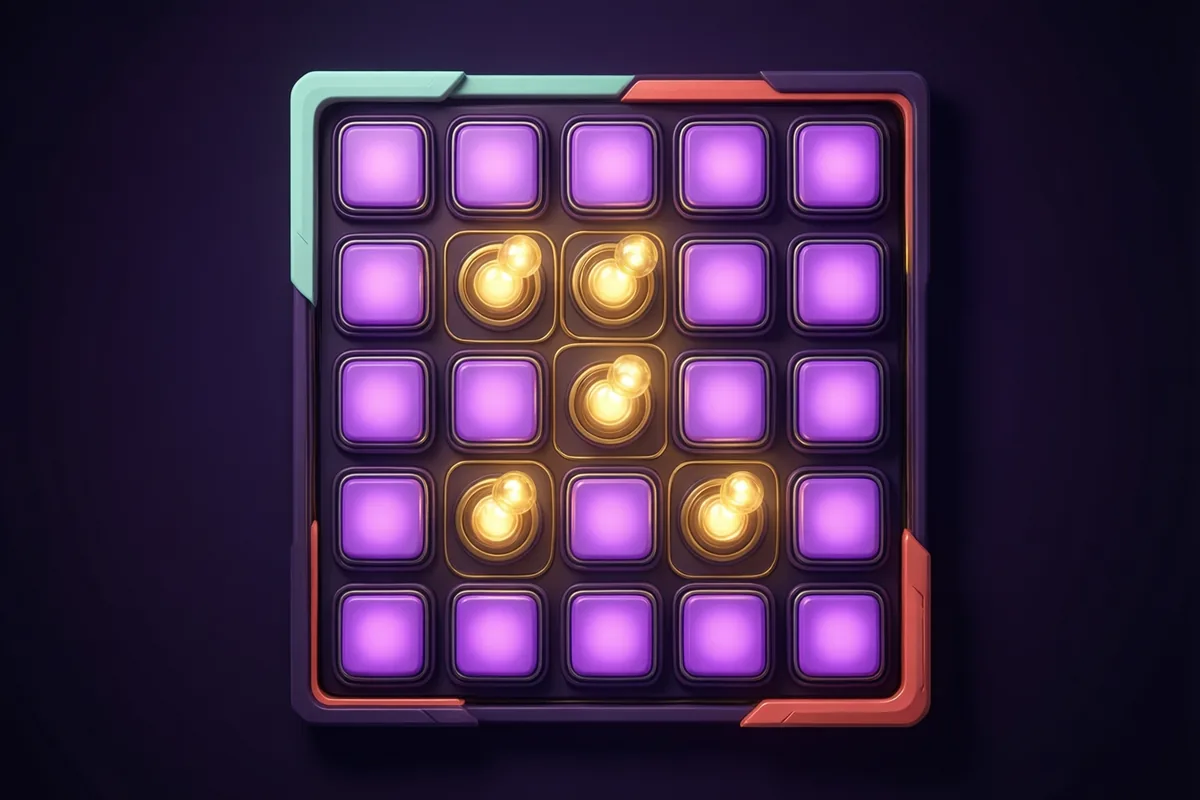
In Lights Out, pressing a cell changes that light and its four orthogonal neighbours, and pressing the same cell twice cancels out.
Order does not matter
The final arrangement depends only on which cells you pressed, not on the sequence. That makes experimenting far less chaotic than it looks.
Work downward
Use each row to clear the lights in the row above it, then deal with the bottom row last.
Presses cancel, so nothing is lost
Because a second press on the same cell undoes the first, no experiment can put the board out of reach. Try a press and read the result.
Start at the top, finish at the bottom
Clearing each row by pressing cells in the row below it leaves only the bottom row to solve. That turns a whole-grid puzzle into a single line.
Hints explain a possible continuation
The Lights Out Hint button calculates a solution for the current board and highlights a cell to press. It does not automatically play the move. You can ask for another hint after pressing a cell to work through a complete solution. All starting boards are generated from a dark grid using the same legal toggle operation.
Mastermind: separate color counts from positions
A Mastermind clue counts colours; it does not point at pegs. An exact clue means a right colour in the right place, and a colour-only clue means a right colour somewhere else.
| Feedback | What it establishes | What it leaves open |
|---|---|---|
| No matches | None of the guessed colours is in the code | Every other colour |
| Colour-only matches | Those colours appear in the code | Where they belong |
| Four total matches | The full set of colours, including repeats | Their arrangement |
Two clue types, one guess
Every guess returns a count of exact matches and a count of colour-only matches. Neither count tells you which peg it refers to, and that is what makes the deduction interesting.
A code peg cannot be counted twice. A code holding two red pegs cannot award four matches to a guess of four reds.
Make the next guess answer a question
Make each guess test one specific question, so the feedback narrows the answer instead of repeating what you know.
Test colours first, positions afterwards
A guess with no matches removes its colours from consideration. Once four total matches fix the set, every later guess is about arrangement.
Use the numbers, not the colours
The pegs are numbered as well as coloured, so you can follow the same deductions without relying on colour.
Ask one question per guess
A guess that changes three things at once returns feedback you cannot attribute. Change one colour or one position, and the difference in the reply tells you what that change was worth.
Work through a toggle example
Open Lights Out for a playable example from this collection, then continue with the English draughts rules guide. Browse the puzzle games collection as more games are added to the public library.
Questions about 15 puzzle, lights out and mastermind
How many guesses do I get in Mastermind?
Ten. The hidden code is four pegs chosen from six colours, and repeated colours are allowed, so there are one thousand two hundred and ninety-six possible codes. Each guess returns a count of exact matches and colour-only matches, and after the tenth the code is revealed.
What is a good first guess in Mastermind?
Use two colours rather than four different ones, for example two of one colour and two of another. The reply then tells you something about repeats as well as about which colours are present. Four different colours in the first guess wastes the chance to learn about duplication.
Do I need maths to solve Lights Out?
No. Pressing a cell flips it and its four orthogonal neighbours, pressing the same cell twice cancels out, and the order of presses does not matter, so the puzzle is about which cells to press rather than in what sequence. The Hint button works out a solution for the current board and highlights one cell if you get stuck.
Can the Fifteen Puzzle reach a position with no legal move?
No. The empty square always touches at least two tiles, even in a corner, so a move is always available. If you feel stuck it is because the move you want would break a section you have already solved, which is a planning problem rather than a dead end.
Why do I keep breaking the rows I already finished?
Because tiles can only move through the empty square, so bringing a new tile in usually means walking the gap through finished ground. Solve the top row first and then keep the gap below it, working in the shrinking area that remains. The last two tiles of a row need to be positioned together rather than one at a time.
These tips refer to the editions in our library. Game controls and behavior can differ elsewhere. Spotted a problem?