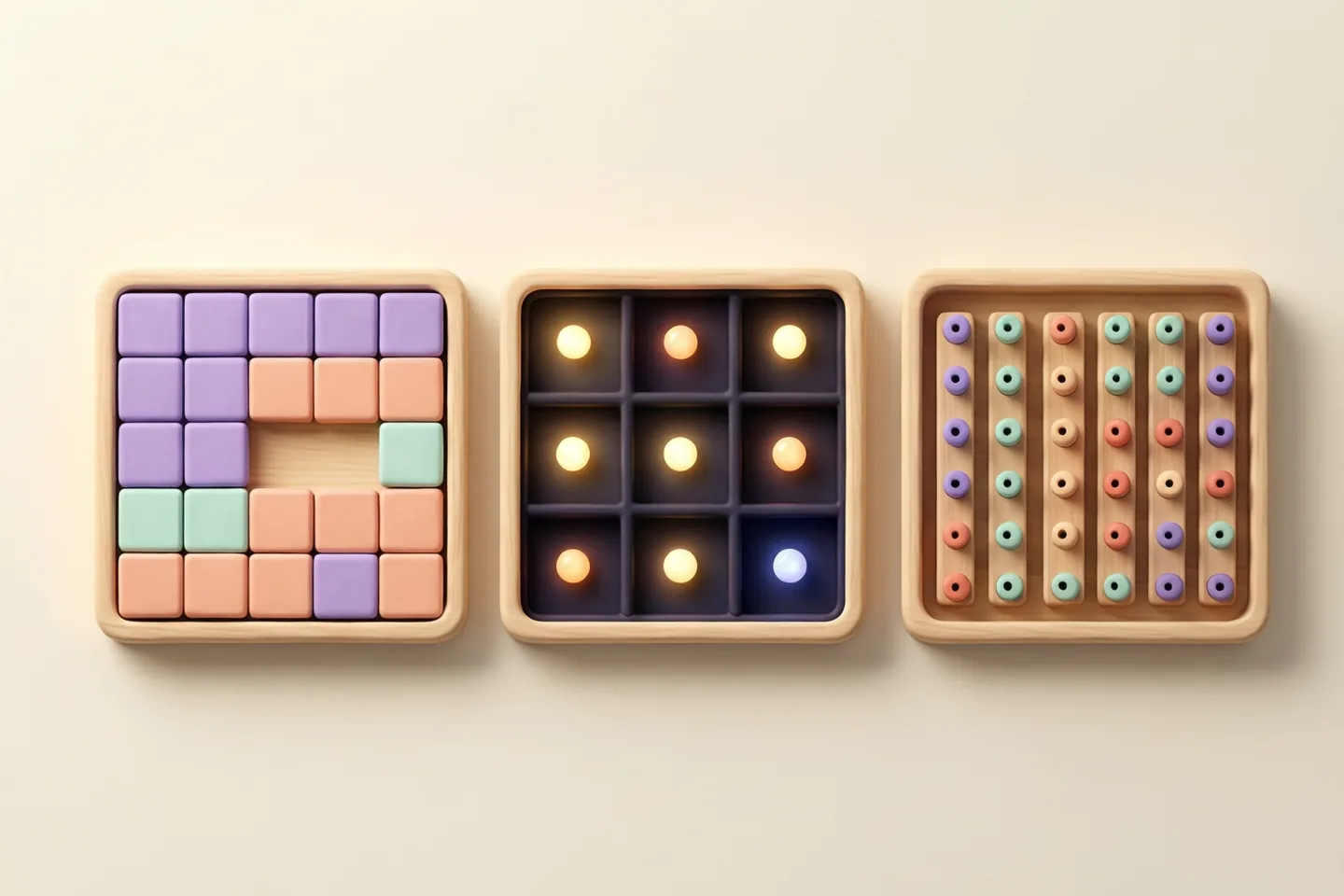
5×5 Nonogram: start where the clues overlap.
Clues describe consecutive filled runs separated by at least one empty square. In five cells, a run of three must cover the center; a five fills the line and a zero empties it. Cross-check rows and columns.
A clue describes runs, not coordinates
A Nonogram clue lists the lengths of the filled runs in a line, in order. It does not give their positions.
| Clue | Meaning | Squares filled |
|---|---|---|
| 3 | One unbroken run of three | 3 |
| 1 1 | Two single squares with at least one gap between them | 2 |
| 5 | The whole line | 5 |
| 0 | The line is empty | 0 |
Order is part of the clue
A clue of 1 3 is not the same as 3 1. The runs appear in the order written: left to right along a row, and top to bottom down a column.
Runs need gaps between them
Two runs in the same line must be separated by at least one empty square. That separator is why a clue of 2 2 exactly fills a five-square line with no freedom left.
Read the whole clue before you fill
A clue lists every run in the line, and the runs need at least one empty square between them. Add the run lengths and the minimum gaps: when that total equals the line length, the line is already determined.
A zero is information
A clue of 0 empties the whole line at once, and every crossing line gains a confirmed empty square. Fill those in before hunting for harder deductions.
Column clues work the same way, read from top to bottom. Every generated board on this site is checked to have exactly one solution.
Find squares that must be filled
A run of three in five cells must fill the middle cell, because every possible placement covers cell 3.
| Run starts at | Filled cells | Shared cell |
|---|---|---|
| Cell 1 | 1, 2, 3 | 3 |
| Cell 2 | 2, 3, 4 | 3 |
| Cell 3 | 3, 4, 5 | 3 |
Cells are numbered from left to right. A clue of 5 fills the whole line. A clue of 2 2 fixes two filled cells, one empty separator and two more filled cells. Use these fixed cells to constrain the intersecting columns.
Mark empty squares with a reason
Mark a square empty only when a rule forces it, then use those marks to keep two runs apart.
Cap a finished run
Once a run reaches its clue length, the squares immediately before and after it must be empty, unless they fall outside the board.
How to record it
Switch the Mark selector to Empty to place an ×, or right-click a cell. Separators stop you joining two runs by accident.
Crosses are deductions too
An × records that a square cannot be filled. That is as useful as a filled square when you come to read the crossing column.
Alternate rows and columns
A row can match its own clue and still sit in the wrong place, because its position depends on the columns. Work in both directions rather than finishing every row first.
Empty marks stop accidental joins
Two runs that touch would read as one longer run. Recording the separator keeps your own pattern honest as the rest of the board fills in.
A clue turns green when the line matches, but keep checking the columns. A row that looks right on its own can still be in the wrong position.
Use assistance deliberately
Check highlights marked squares that conflict with the solution; it does not fill unmarked cells. Hint reveals one square directly from the solution, so it is an assist rather than a deduction explanation. Undo restores the previous mark and move count. You win when every required filled square is correct and no extra filled squares remain. Empty squares may be crossed or left blank, letting you decide how much notation is useful.
Mark the overlap you can prove
Open Concentration for a playable example from this collection, then continue with the Peg Solitaire jump guide. Browse the puzzle games collection as more games are added to the public library.
Questions about 5×5 nonogram
Can a Nonogram be solved by logic alone?
Every board generated here has exactly one solution, so there is always a single correct answer to find. On a five by five grid you can usually reach it by working one line at a time and using the crossings. A unique answer does not by itself promise that a purely line-by-line path exists at every step.
What do I do when no line can be filled with certainty?
Switch from filling to eliminating. Mark squares empty where a rule forces it, then reread the crossing lines, because a single confirmed empty square often fixes a run's position. The clue with the largest number in the shortest line is usually the one that gives way first.
Why is my grid full but the puzzle not finished?
Because the pattern is in the wrong place. A row can match its own clue perfectly and still sit one square off, which only shows up against the columns. You win when every square that should be filled is filled and no extra squares are, so check a column you have not looked at recently.
Are there larger grids than five by five?
Not in this edition. Every puzzle here is a five by five grid with a checked, unique solution, and the size is fixed. That keeps a round short enough to replay a decision, which is the point of practising the deductions on it.
These tips refer to the editions in our library. Game controls and behavior can differ elsewhere. Spotted a problem?