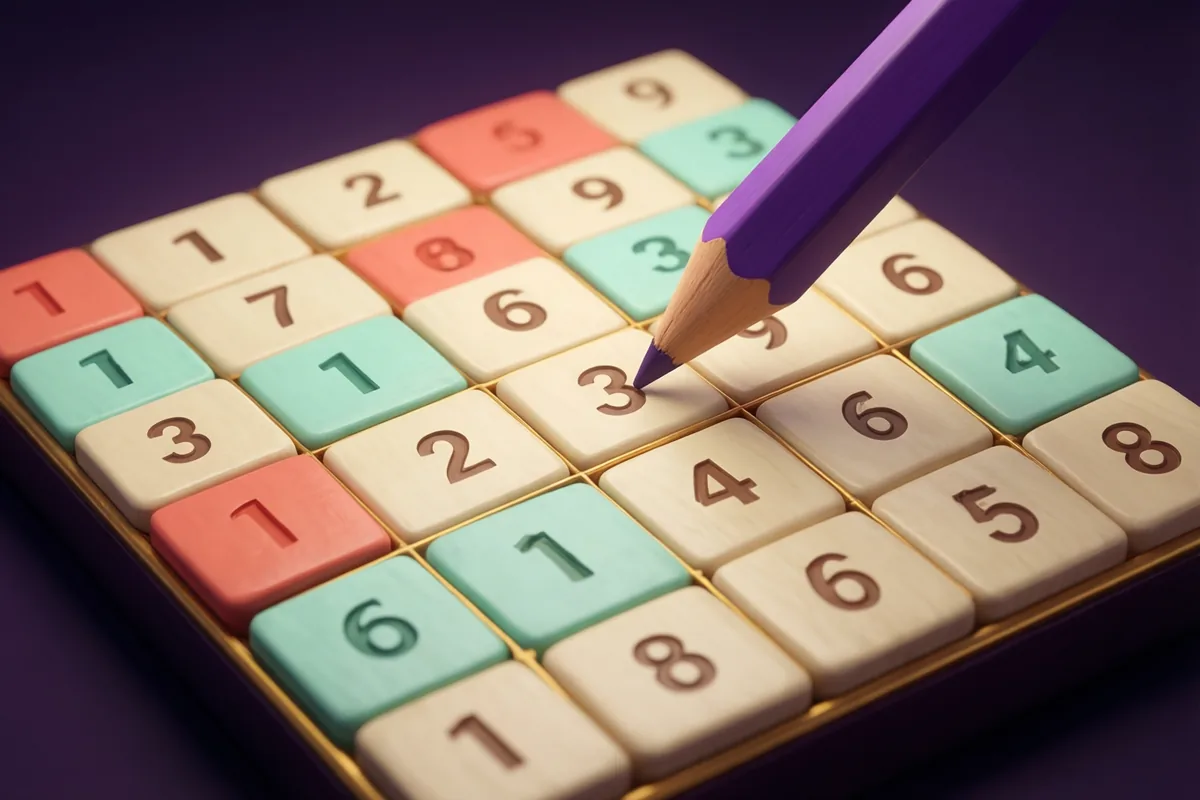
Sudoku for beginners: start with what you know.
Each row, column and 3×3 box must contain the digits 1–9 once. Begin with a cell or group that has only one possibility, then use notes to record candidates when the next digit is uncertain.
The three checks
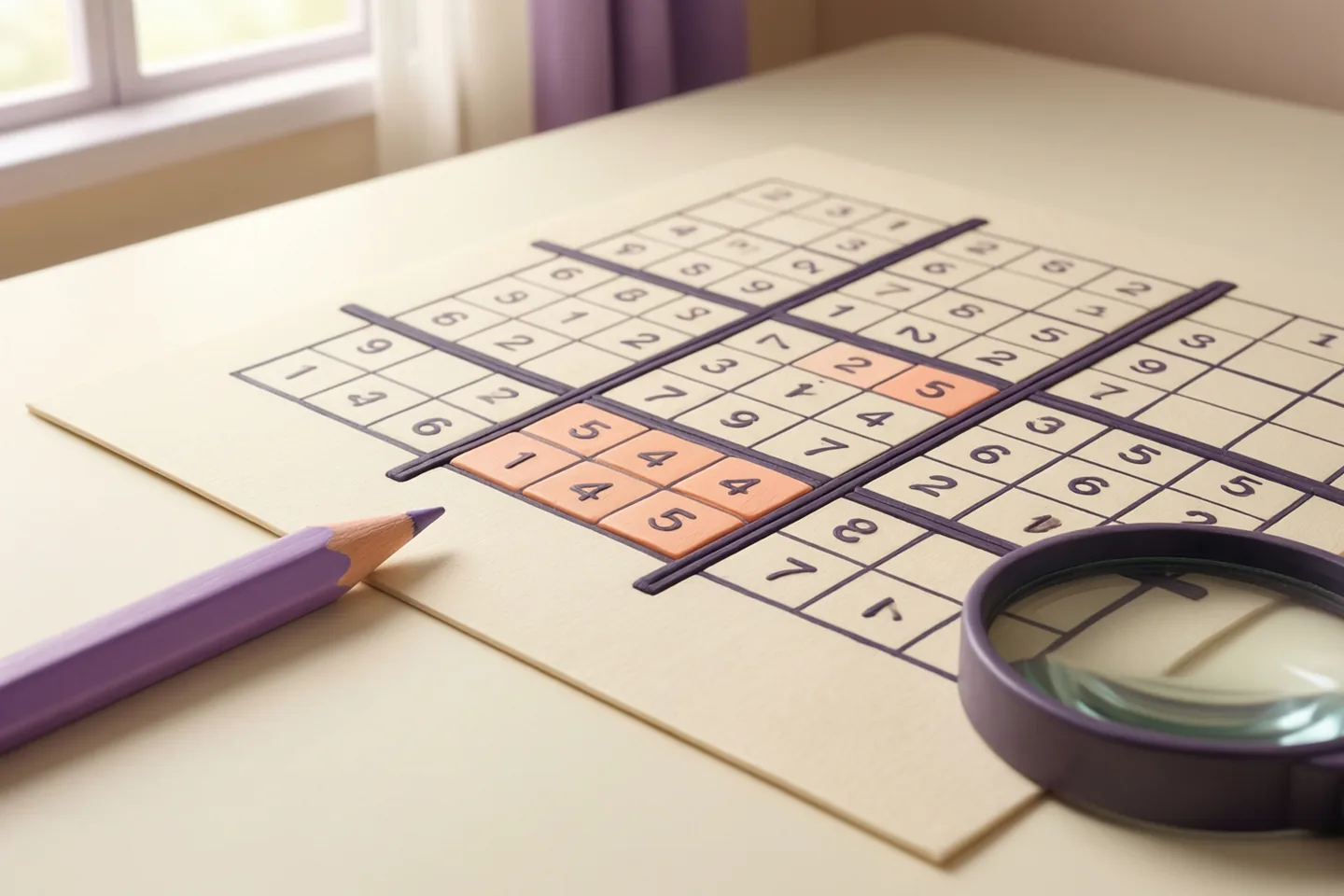
Every Sudoku cell belongs to three groups: a row, a column and a 3 × 3 box. Check all three before you write a digit.
| Group | Size | Rule |
|---|---|---|
| Row | Nine cells | Holds 1 to 9, once each |
| Column | Nine cells | Holds 1 to 9, once each |
| Box | Three by three cells | Holds 1 to 9, once each |
Three groups, one cell
The row, the column and the box constrain the same cell at once, and a digit must satisfy all three. That is why checking one group is rarely enough to place a number.
Nine cells, nine digits, no repeats
Each row, each column and each box holds the digits 1 to 9 exactly once. Every deduction in the game comes from that single rule.
Start where the board is fullest
A row, column or box that already holds seven or eight digits leaves very little room for the rest. Those groups are where the first placements usually come from.
A digit can fit the row and still clash inside its box. The dark starting clues cannot be edited in our game.
Find a naked single
A naked single is a cell with only one possible digit after checking its row, column and box.
- Suppose the row excludes 1, 2 and 3.
- The column excludes 4 and 5.
- The box excludes 6, 7 and 8.
- Only 9 remains, so place 9 in the cell.
The conclusion comes from combining all three groups. Checking only the row would leave several possibilities.
Find a hidden single
A hidden single is a digit that fits in only one cell of a group, even when that cell has several candidates noted in it.
Look at the group, not the cell
Take one box and ask where the digit 7 could go. If only one cell in that box accepts it, place it there.
Why it is called hidden
The certainty belongs to the digit, not to the cell. That cell may still show four or five notes, which is why beginners walk past it.
Naked and hidden singles compared
A naked single is about one cell with one candidate left. A hidden single is about one digit with one home left in a group. Both are certain; they simply arrive from opposite directions.
Where to look for hidden singles
Boxes are usually the easiest group to scan, because all nine cells sit together on screen. Pick a digit, then look for a box where only one cell can take it.
Make notes useful
Use Notes mode to record possible digits. After placing a number, revisit the affected row, column and box and remove candidates that no longer fit. Notes become misleading if you treat them as permanent. The Check button highlights current conflicts; it is a way to catch mistakes, not a substitute for deduction.
Slow down when progress stops
When you stop finding moves, rescan the groups your last placement changed rather than guessing.
Start from the digit you placed last
One solved cell can unlock another at the far end of its row. Re-read the row, the column and the box that cell belongs to.
Suspect your own notes
A candidate deleted by mistake hides a valid move. If nothing appears, rebuild the notes for the emptiest group.
Rescan, do not restart
Most stuck boards are not really stuck. Re-reading the three groups around your last placement usually finds the next move faster than beginning again.
Check before you guess
The Check button highlights conflicts on the current board. It will not tell you which cell to fill, but it will tell you that a mistake has already crept in.
One placement changes three groups
Every digit you write affects a row, a column and a box at once. Rescanning all three is what turns a single placement into the next one.
Take a break rather than filling a cell just to keep the board moving. A guessed digit costs more time than a pause.
Apply one deduction at a time
Open Sudoku for a playable example from this collection, then continue with the Minesweeper pattern guide. Browse the puzzle games collection as more games are added to the public library.
Questions about sudoku for beginners
Where should I look first on a new Sudoku grid?
Look at the fullest row, column or box, because the most filled group leaves the fewest possibilities. A box with six digits already placed often gives you a cell with only one candidate straight away. Working from the crowded parts outward keeps you finding placements instead of scanning empty space.
Is it worth writing candidates into every empty cell?
No, and doing it early usually slows you down. Note candidates in the group you are actually working on, then update that group after each placement. Notes that are not maintained become wrong, and a wrong note is worse than no note.
What do I do if I find the same digit twice in one row?
One of the two is wrong, so erase both and rebuild that area from the starting clues, which cannot be edited. Press Check to see which of your entries clash with a row, column or box. Bear in mind that no conflicts showing does not confirm the rest of the grid is right.
Can I get stuck in a Sudoku with no move left?
Not in a correctly filled grid. Every puzzle on this site is generated with exactly one solution, so a position with nothing to place means an earlier entry is wrong. When you stall completely, look for your mistake before looking for a harder technique.
Does solving Sudoku make you better at anything else?
It makes you better at Sudoku. We are not going to claim it improves memory or general reasoning, because that is not something this site can back up. Play it because a proved placement is satisfying, which is reason enough.
These tips refer to the editions in our library. Game controls and behavior can differ elsewhere. Spotted a problem?