 QUICK PICK
SudokuPuzzle·Free to play
 Free-Games.toSign inSurprise me
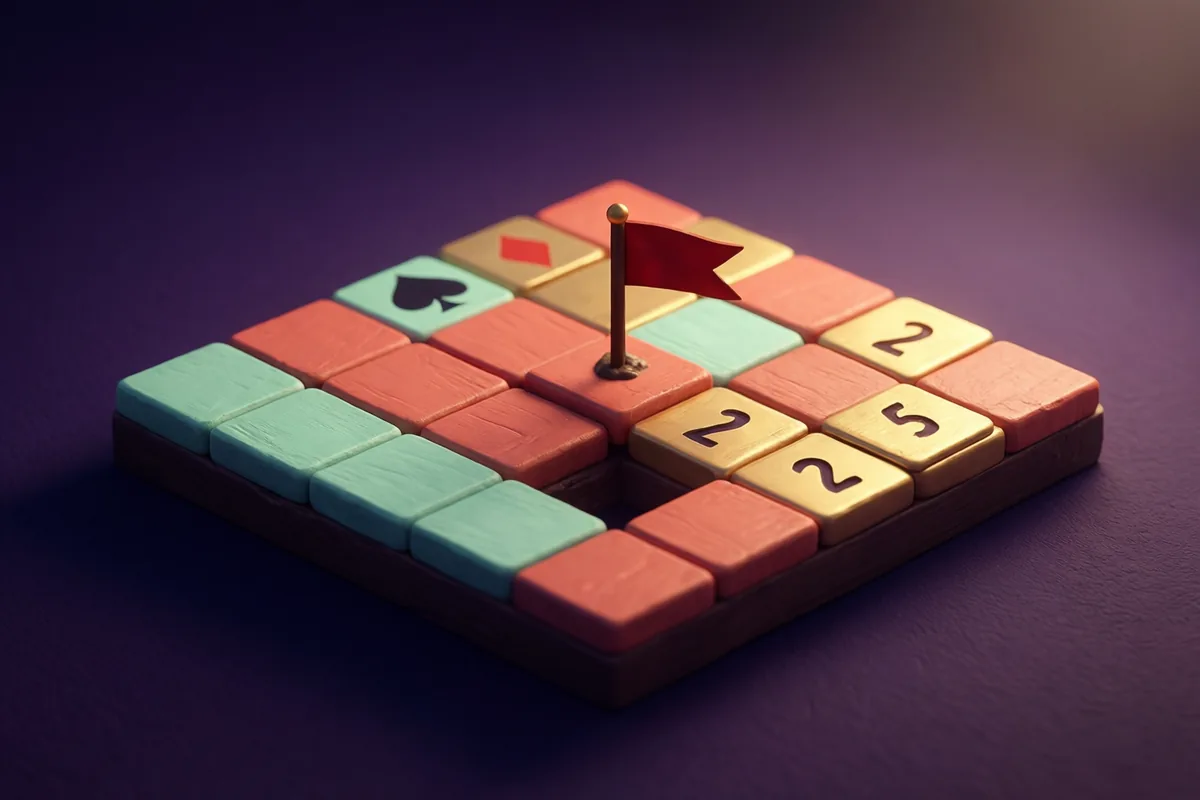
Reveal the safe squares and flag the hidden mines.
Sign in to save your scores and play history, or keep playing as a guest. Recent game activity and scores appear on the homepage with a masked email or IP address.
 Minesweeper
Your first reveal is safe. Numbers tell you how many of the eight neighboring squares contain mines.
Right-click to flag a square, or enable Flag mode on a touch screen.
Reveal every square that does not contain a mine. A flag alone does not reveal a safe square.
This Minesweeper game is built for Free Games. Read about controls and local storage.
Ready for a different problem? Bubble Shooter sits in the same collection, and it asks you to read the board rather than repeat the habit this game rewards. Switching between the two is a fair way to find out which skill is actually holding your score back.
Minesweeper is a counting puzzle wearing the costume of a game of nerve. The board here is 9 cells across and 9 down, 81 squares in total, and 10 of those squares hide a mine. Uncover all 71 safe squares and you win. Uncover a mine and the round ends at once.
Every number you reveal counts the mines touching that square, including diagonals, so a square can show anything from 1 to 8. A square with no mines nearby shows nothing and opens its neighbours automatically, which is why one good click can clear a quarter of the board. Your first click is always safe: the mines are placed after it, around wherever you tapped. That means the opening move is free and the guessing starts later, if at all.
Right-click, or switch on Flag mode on a touchscreen, to mark a square you believe hides a mine. The counter above the board tracks how many flags you have placed against the 10 mines. Flags are notes to yourself, not proof. Most boards are cracked by comparing two clues that share covered squares, which is the whole subject of the Minesweeper pattern guide. If you like deduction with no clock, Sudoku asks the same kind of question in a different language.
| Genre | Puzzle Games |
|---|---|
| Challenge | Deduction with occasional forced guesses |
| Pace | Bursts of thought, then quick clearing |
| Original era | 1990, in the Microsoft Entertainment Pack |
| Players | Single player |
| Controls | Click / tap, Right-click / hold / Flag mode, Click a revealed number, Level selector |
| Cost | Free, with no account and no download |
The idea predates Windows. Mainframe games such as Cube in 1973 and Jerimac Ratliff's Hurkle already asked players to find hidden objects on a grid from numeric hints. The direct ancestor is Mined-Out, written by Ian Andrew and published by Quicksilva for the ZX Spectrum in 1983, followed by Relentless Logic on MS-DOS in 1985.
The version everyone remembers was written by Robert Donner and Curt Johnson at Microsoft and shipped with the Microsoft Entertainment Pack in 1990, then bundled with Windows 3.1 in 1992. That bundling is the whole story of its fame. The game was on hundreds of millions of office computers by default, next to Solitaire, and it quietly taught a generation to use the right mouse button.
Competitive play grew up around the three standard boards: beginner at 9 by 9 with 10 mines, intermediate at 16 by 16 with 40, and expert at 30 by 16 with 99. Our board matches the beginner size. Other classic desktop puzzles live in the puzzle collection.
No. The mines are not placed until after your first reveal, and the game lays them anywhere except the square you chose. Your opening click is always safe, and it often opens a large blank area straight away.
A number counts the mines in the eight squares touching it, corners included. A 1 has exactly one mine among its neighbours, a 4 has four. A blank revealed square has none, so the game opens its neighbours for you.
Ten, on a 9 by 9 grid of 81 squares. That leaves 71 safe squares, and the counter above the board shows the mine total alongside how many flags you have currently placed.
No. A flag is only your own marker. The game does not check it and will not stop you flagging an empty square. Winning requires revealing all 71 safe squares, and a board covered in correct flags is still unfinished.
Mostly no, occasionally yes. The great majority of positions can be solved by comparing clues that share covered squares. A small number of endings leave two squares and one mine with no information to separate them, and there the coin flip is genuine.
Tap the Flag mode button above the grid to switch it on, then tapping a square places or removes a flag instead of revealing it. Turn it off to go back to revealing. On a desktop, right-click does the same job without switching modes.
Learn to subtract one clue from another. When a 2 and a 1 sit side by side and share covered squares, the extra mine belongs to the squares only the 2 can see. That single habit removes most of the guessing.
Four games from the same shelf, each with its own pace. The one-line summaries are how their own pages describe them.
| Game | What it is like | Pace | Play |
|---|---|---|---|
| Sudoku | Fill each row, column and 3 × 3 box with the digits 1–9. | As slow as you like, no timer pressure | Play |
| Lights Out | Switch off every light on the five-by-five board by toggling cells and their neighbors. | Two to ten minutes per board | Play |
Learn the basic deductions before relying on memorized patterns.
QUICK PICK NEW GAME
Shortcuts