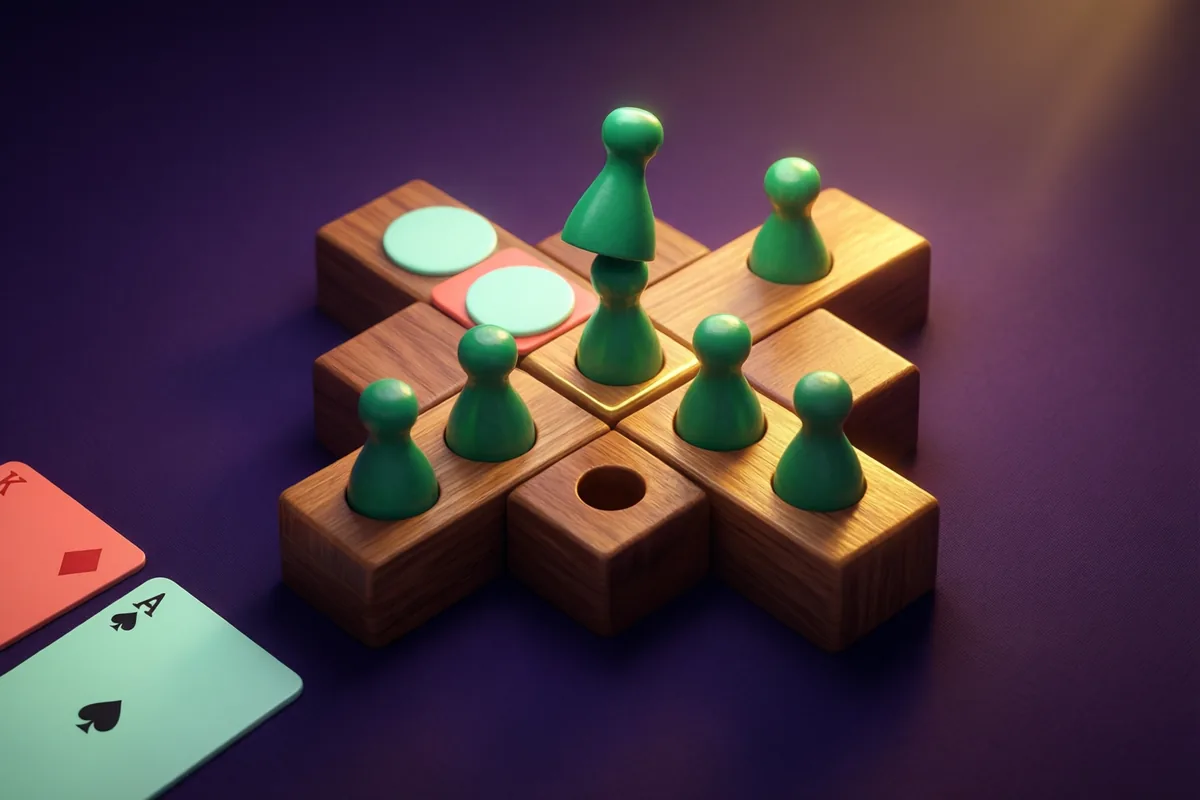
Peg Solitaire rules: keep the next jump connected.
Jump a peg horizontally or vertically over a neighboring peg into an empty hole, removing the jumped peg. Leave one peg to win. Keep the arms connected and use Undo if a sequence strands a peg.
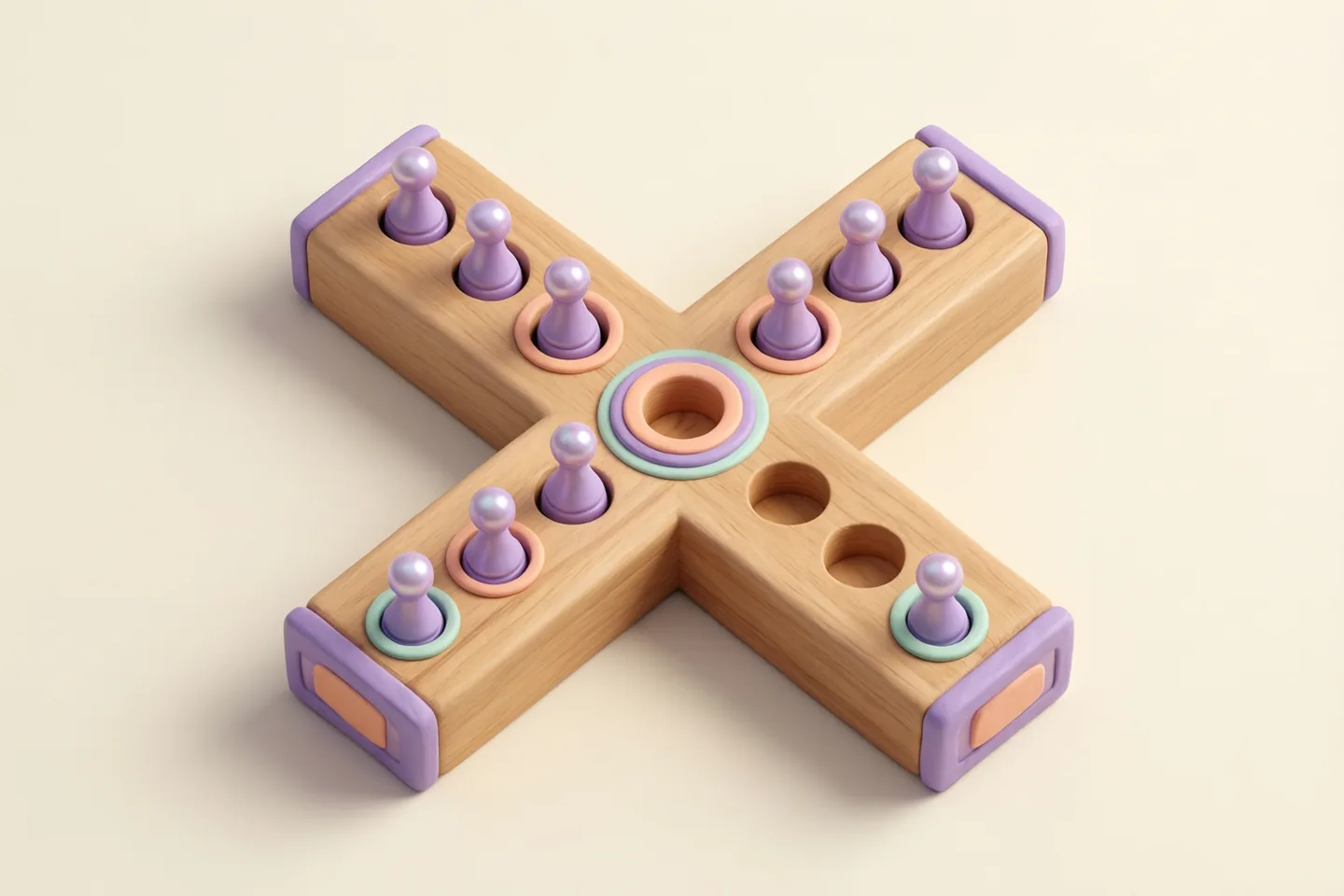
Every jump uses three holes
A legal Peg Solitaire jump uses three holes in a straight horizontal or vertical line: two occupied holes followed by an empty landing hole.
- Select the moving peg.
- Jump over the adjacent peg into the empty hole two spaces away.
- Remove the peg that was jumped.
The English cross starts with 32 pegs around an empty center. New game restores the same opening arrangement, allowing you to compare sequences.
Avoid leaving an isolated survivor too early
Do not clear an outer arm before you know how its last peg will leave the board.
An isolated peg cannot move alone
A jump needs two pegs in line with an empty hole beyond. A single peg on an outer arm has nothing to jump and nothing to be jumped by.
Ask the question before you empty an area
For each region you are about to clear, decide whether its final peg moves toward the centre or gets jumped by a neighbour.
Keep the board connected
Pegs are useful only while they can still reach each other. Clearing an area completely can leave one peg with no partner and no landing hole.
The outer arms have the fewest options
Pegs on the arms of the English cross have fewer neighbours, so they have fewer ways to leave the board. Work inward, where a peg has partners in more directions.
Look at the hole, then find the pair
An empty hole is only an opportunity when two pegs sit in line beside it. Scan for the pair first and the landing hole second.
Clearing an area is a commitment
Once a region has one peg left, its options are almost gone. Decide how that last peg leaves before you take the second to last one.
An empty hole only helps when a neighbouring pair can reach it.
Think backward from a possible finish
A final jump needs two pegs with an empty landing hole in line. Imagine which three holes might support that last jump, then consider how the preceding move could create the pair. You do not need to plan every jump at once. Preserving a useful connection between two parts of the cross is already a more specific goal than removing whichever peg is easiest.
Compare sequences with Undo
When no jumps remain, the game reports how many pegs are left and keeps Undo available so you can test another line.
Compare two endings from one position
Reverse a jump, choose a different landing and see which options appear. That comparison is the quickest way to learn the shape of the board.
What counts as a win here
This edition accepts one remaining peg anywhere on the board. Finishing with that peg in the centre is an extra challenge you set yourself.
Undo makes this a study tool
Because Undo stays available at a dead end, you can test two continuations from the same position. That comparison teaches more than restarting the whole cross.
Count what is left, then look at where
Three pegs in a cluster is much closer to a solution than three pegs spread across separate arms. The number on its own does not tell you how close you came.
Legal is not the same as useful
The highlighted holes show every jump the rules allow, and most positions offer several. Only some of them keep the remaining pegs connected.
Undo keeps the move count honest
Reversing a jump restores the position exactly, so you can explore without starting again. Treat a dead end as a branch to test rather than a failed run.
There is no automatic solution button. Highlighted holes show legal jumps; they do not promise a winning continuation.
Compare two legal continuations
Open Peg Solitaire for a playable example from this collection, then continue with the Hangman strategy guide. Browse the puzzle games collection as more games are added to the public library.
Questions about peg solitaire rules
How many jumps does a complete solution take?
Thirty-one. The English cross starts with thirty-two pegs, every jump removes exactly one, and finishing with a single peg therefore takes thirty-one moves in a row. There is no way to shorten that, so the challenge is which jumps, not how many.
Is there a best first jump?
The opening position offers exactly four jumps, one from each direction into the empty centre, and they are mirror images of each other. So the first move cannot be a mistake. The second move is where the position starts to differ, and that is where the thinking begins.
What should I do when only a few scattered pegs are left?
Stop and count whether any two of them can still reach a shared empty hole in a line. A peg with no partner within a jump is already stranded, so the useful move earlier is the one that keeps groups connected. When no jumps remain, the game tells you how many pegs are left and Undo stays available for another try.
Why is it called solitaire when there are no cards?
Solitaire just means a game for one player. The board game is much older than the card games that borrowed the name, and it has no deck, no dealing and no chance at all. Every position you reach is the result of your own jumps.
These tips refer to the editions in our library. Game controls and behavior can differ elsewhere. Spotted a problem?