
Chess ClockTiming tool·Free to use
 Free-Games.toSign inSurprise me
Make a line of three against the computer or a friend on the same device.
Sign in to save your scores and play history, or keep playing as a guest. Recent game activity and scores appear on the homepage with a masked email or IP address.
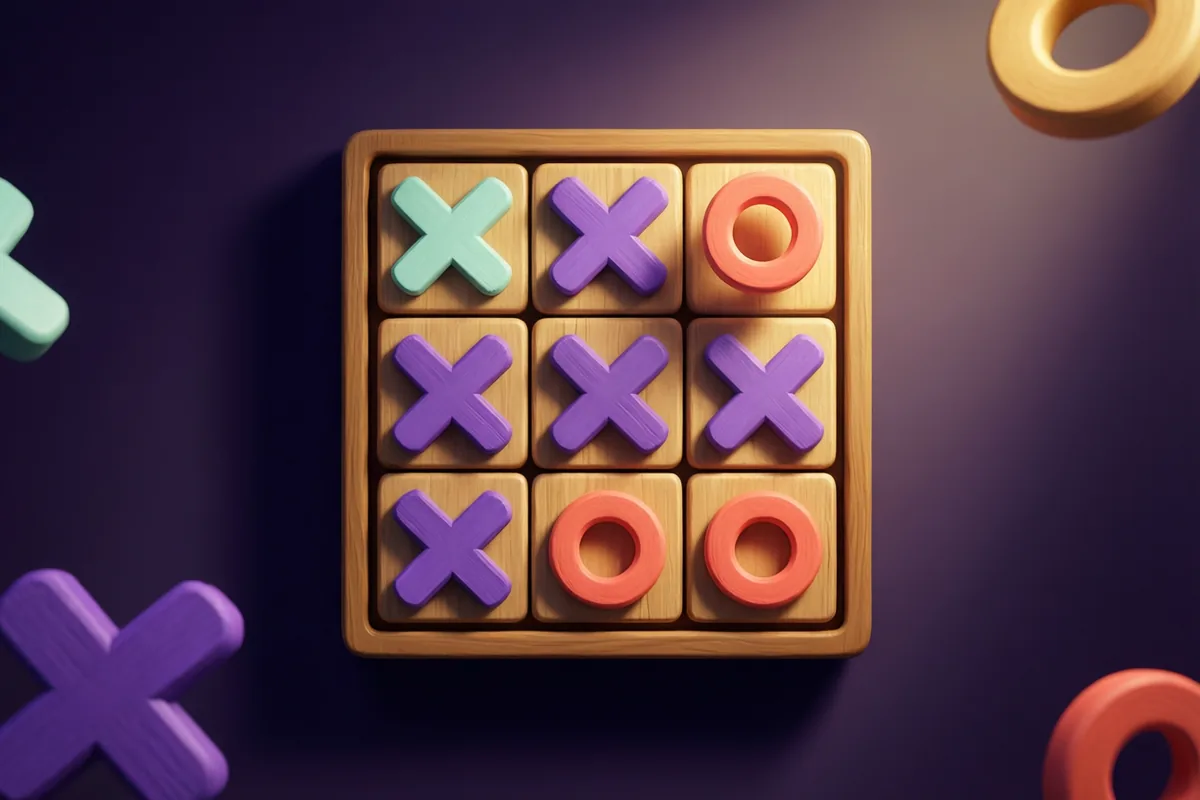 Tic-Tac-Toe
No. Choose Computer to play the built-in opponent, or 2 players to take turns on the same device. This edition does not connect remote players.
X moves first. Place your mark in any empty square.
Three matching marks in a row, column or diagonal win. A full board without a line is a draw.
This Tic-Tac-Toe game is built for Free Games. Read about controls and local storage.
A fork creates more than one threat for the opponent to answer. Connect Four adds gravity, so an apparently winning square matters only when a disc can reach it.
For another pencil-and-paper grid game with deeper tactics, the Dots and Boxes chain strategy explains why opening a chain can hand over several boxes at once.
Tic-Tac-Toe fits in nine squares and about twenty seconds, which is exactly why it has survived. You and your opponent take turns marking empty squares. X goes first. Three of your marks in a row, a column or a diagonal wins immediately, and a full board with no line is a draw.
Here is the honest part. Tic-Tac-Toe is a solved game. With correct play by both sides, every single game is a draw. The computer opponent on this page searches the whole game tree before each move, so it plays perfectly and cannot be beaten. It can only be drawn. That sounds discouraging until you realise it makes the game a training tool rather than a contest: the machine will punish any mistake, so a draw against it means you played faultlessly.
Choose 2 players in the opponent selector to hand the device back and forth instead. Against a human, the game becomes about the fork, a move that creates two winning threats at once so only one can be blocked. That single idea is unpacked in the forks guide. When you want the same threat-making idea on a bigger board, Connect Four is the natural next step.
| Genre | Board Strategy Games |
|---|---|
| Challenge | Simple to learn, unbeatable computer |
| Pace | Under a minute per game |
| Original era | Roman era as Terni Lapilli, named in 1864 |
| Players | Two players on one device, or against the computer |
| Controls | Click / tap / 1–9, Level selector, Play as, Opponent selector |
| Cost | Free, with no account and no download |
Three-in-a-row games are ancient. Grids scratched into Roman roof tiles have been linked to a game called Terni Lapilli, in which each player had only three counters and moved them once all were placed. Similar patterns appear in Egyptian sites, though dating loose scratches on stone is uncertain and claims of an exact age should be treated carefully.
The English name is Victorian. "Tick-tack-toe" comes from an unrelated children's game in which players closed their eyes and stabbed a pencil at a numbered slate, chanting the words. The name attached to the noughts and crosses grid in the nineteenth century, and Britain has largely kept the older name.
The game has an outsized place in computing. In 1952 Alexander Douglas built OXO on the EDSAC at Cambridge as part of a thesis on human-computer interaction, making it one of the first video games with a graphical display. Donald Michie later built MENACE in 1961, a machine of 304 matchboxes filled with coloured beads that learned to play by being rewarded. Other two-player boards are collected in the board game strategy guide.
No, and that is deliberate. The opponent evaluates every possible continuation before choosing, so it never makes a losing move. The best result available to you is a draw. If you draw every game, you are playing the position correctly.
It does not. It never changes a placed mark, never peeks at anything hidden, and never moves twice. It simply calculates further than a person usually bothers to, which on a nine-square board means all the way to the end.
X always moves first, and in two-player mode X is whoever takes the first turn on the shared device. First move is a real advantage against imperfect play, so swap who starts if you are playing a series with a friend.
A fork is one move that creates two separate lines of two, each one move from winning. Your opponent can block only one of them, so the other wins next turn. Setting up a fork is the only way to beat a non-perfect player.
The centre is part of four possible lines, more than any other square, so it is the strongest single square. Against a perfect opponent it still only draws. Against a person, an opening corner tends to create more fork chances because it invites a wrong reply.
Yes. Set the opponent selector to 2 players and pass the phone or keyboard between turns. Nothing needs to be installed and no account is required.
Because the board is small enough to be solved completely. There are 255,168 possible games, and correct play by both sides always leads to a full board with no line. Wins only exist where somebody errs.
Four games from the same shelf, each with its own pace. The one-line summaries are how their own pages describe them.
| Game | What it is like | Pace | Play |
|---|---|---|---|
| Chess Clock | Time a game on your own chessboard with two configurable countdown clocks. | Whatever you set, from 1 to 180 minutes | Play |
| Connect Four | Drop discs into a seven-column board and make a line of four before your opponent. | Three to six minutes a game | Play |
| Reversi | Outflank opposing discs and finish with the most discs on an eight-by-eight board. | Around ten minutes a game | Play |

A short guide to winning moves, blocks and forks.
 NEW GAME
 NEW GAME
Shortcuts