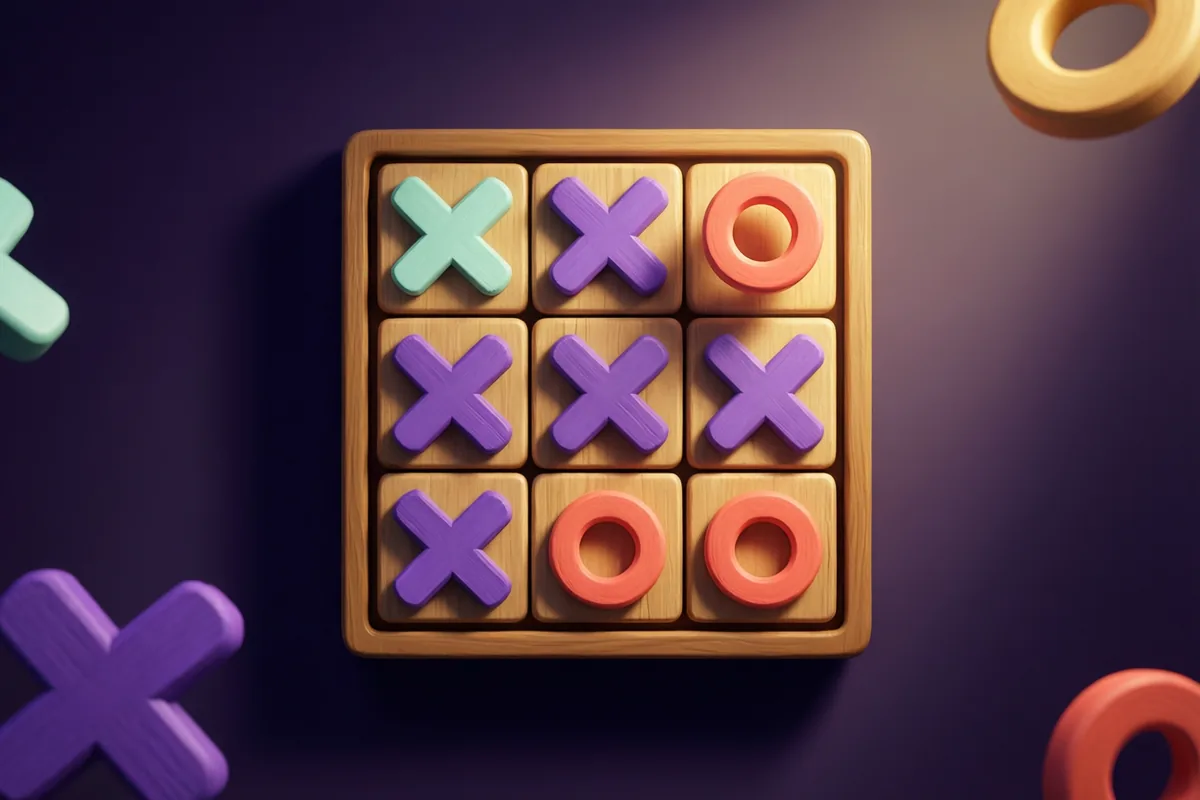
Tic-Tac-Toe forks: create and block two threats.
Take an immediate winning move before blocking. If there is no win, stop the opponent’s next line and look for a fork that creates two threats. Correct play against the computer can end in a draw.

Check wins before threats
Check for your own winning move first, then for the opponent’s, and only then think about position.
- Look for a move that completes your own line, and play it.
- If there is none, find the square where the opponent would win next turn and block it.
- If neither exists, choose a move that builds toward two lines at once.
Two checks, in this order
Your own win first, the opponent’s block second. Reversing that order is the most common way a winnable game turns into a loss.
There are only nine squares
You can examine every one of them on every turn. Tic-Tac-Toe is small enough that a complete check is faster than a hunch.
Check the diagonals last but never skip them
Rows and columns are easy to scan; diagonals are the ones players miss. Add both diagonals to your check before you decide the board is quiet.
This order prevents most avoidable losses. Blocking a threat while missing your own win gives the game away.
Create a fork
A fork is one move that creates two lines each needing a single further mark, so one block cannot stop both.
Why two threats win
The opponent places one mark per turn. Two independent threats mean one of them survives the reply.
Corners join more lines than edges
A corner belongs to a row, a column and a diagonal. An edge belongs to a row and a column only, which is why corner play produces more forks.
The centre belongs to four lines
The centre square sits on a row, a column and both diagonals. A corner sits on three lines and an edge on two, which is why the centre is taken first so often.
Two threats, one reply
The opponent answers one threat per turn. A fork is simply a position where you have made more threats than they have turns to answer.
Build toward two lines, not one
A mark that sits on two unfinished lines is worth more than a mark that extends one. That is the practical way to look for a fork while you play.
Prevent the setup
Stop a fork by making a move the opponent must answer, not by taking the most attractive empty corner.
Force a reply
An edge move that creates your own threat forces the opponent to block. They then have no spare turn to build the second threat.
Check every reply before you relax
Look at all of the opponent’s next moves. A quiet-looking position is safe only when none of them creates two threats at once.
A threat buys you a turn
Every move that threatens a win forces a block. A forced block is a turn the opponent cannot spend on building a fork of their own.
Against correct play, expect a draw
The computer here searches the remaining moves, so a well-played game ends level. Treat a draw as the right result rather than a failure.
A draw can be the right result
Tic-Tac-Toe has a small enough game tree for the computer here to search the remaining moves. Against correct play, expect a draw rather than an endless supply of wins. Choose two-player mode for alternating turns with someone beside you; this mode uses the same device.
A legal fork to trace on the board
A fork creates two immediate winning threats that one opposing move cannot cover. This legal sequence shows a fork after O chooses a weak corner.
- X takes top-left.
- O takes the center.
- X takes bottom-right.
- O takes top-right.
- X takes bottom-left, blocking O’s diagonal and creating the fork.
X now threatens middle-left to finish the left column and bottom-middle to finish the bottom row. O has no immediate win and can block only one threat. Try the sequence in two-player mode; it is not a forced win against the correctly playing computer.
Practice forks before adding gravity
Open Tic-Tac-Toe for a playable example from this collection, then continue with the chess clock increment guide. Browse the board strategy games collection as more games are added to the public library.
Questions about tic-tac-toe forks
What is the best reply when the opponent takes the centre?
Take a corner. A corner reply keeps you on two lines through the centre square and gives you the most ways to build a threat later. Answering in a side square leaves you defending from the start.
Do forks work against a computer that plays perfectly?
No. A fork needs the opponent to make a move that ignores a threat, and the computer here searches the remaining moves and will not do that. Practise forks in two-player mode, where a real opponent can miss the setup.
Is there any advantage to going second?
No, going second is the harder side, and your realistic goal is a draw. The second player is answering threats rather than making them, so the discipline is to block the immediate threat and only then look at position. If the first player errs once, a fork usually becomes available.
How do I teach a child to stop losing at this?
Give them one rule at a time, in order. First, always take a winning move if you have one. Then, always block the opponent's winning move. Only when those two are automatic should you introduce making two threats at once.
These tips refer to the editions in our library. Game controls and behavior can differ elsewhere. Spotted a problem?