Dots and Boxes: see the chain before it opens.
Drawing a box’s fourth side claims it and gives another turn. Count both boxes beside an interior edge: it can complete two boxes at once, or expose a chain of captures to the opponent.
Read a box by its sides
Count the sides a box already has before you draw an edge next to it, because that count tells you what the opponent can do next.
| Sides before | Sides after | What it offers |
|---|---|---|
| 0 | 1 | Nothing immediate |
| 1 | 2 | Nothing immediate |
| 2 | 3 | The opponent a fourth side, a point and another turn |
| 3 | 4 | You the box, the point and another turn |
Third sides are the currency
The first and second sides of a box are safe to draw. The third side is the move that hands a point away, so much of the game is about who runs out of safe edges first.
The board holds nine boxes. An outside edge borders one box, while an interior edge borders two, so check both neighbours before drawing.
Follow the extra turn
Completing a box keeps you on move, and if your next edge also completes a box you continue again.
A chain is a run of extra turns
Several nearly complete boxes that lead into one another form a chain. Trace where the sequence can go before you open it.
The turn passes only when nothing is claimed
Your run ends on the first edge that completes no box, so decide in advance which edge that will be.
An extra turn is not always good news
Once a chain opens, the player taking the boxes must keep drawing after the last one. That final edge often opens the next chain for the opponent.
The board uses both colours and initials, so a claimed box stays identifiable without relying on colour alone.
Look on both sides of an edge
An interior edge can be the missing fourth side of two boxes at once, which is worth two points and an extra turn.
Check both neighbours of every edge
A double capture is easy to miss when you are watching one square. Look at the box on each side before taking a smaller capture elsewhere.
A quiet edge can still be expensive
An edge that claims nothing can leave two boxes with three sides each. Counting both neighbours catches that too.
One edge, two boxes
Only interior edges have two neighbouring boxes, and those are the edges worth checking twice. An outside edge can never claim two boxes at once.
Use short games to compare choices
A nine-box board finishes quickly enough to replay a decision. Play the computer to practice spotting completed boxes, or use two-player mode to discuss when a chain first became unavoidable. The computer favors immediate boxes and avoids obvious third sides; it is not advertised as a perfect solver. Your score is the number of boxes you own when every edge is used, not the number of lines you draw.
Follow three captures without changing turns
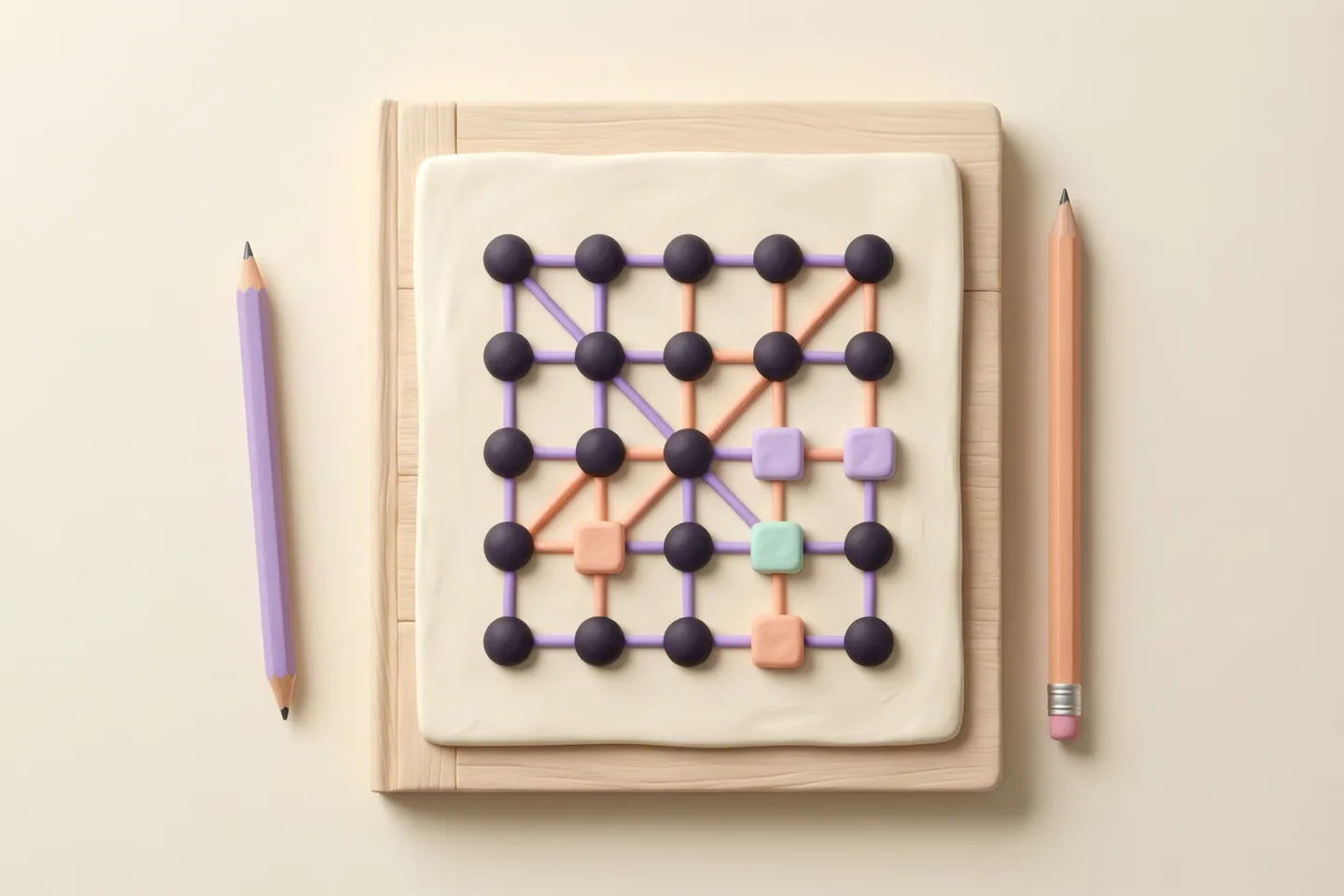
The diagram is the complete nine-box board. Dots mark corners, solid strokes are drawn edges and small middle dots are unused spaces. The numbers 1, 2 and 3 show the next vertical edges in the top row. Orange is to move.
- Build this setup without claiming a box: alternate players across the top three horizontal edges, then the three horizontal edges immediately below them, then the upper-left outside vertical edge. Violet starts, so Orange moves after these seven edges.
- Orange draws edge 1 and completes the first box. Orange keeps the turn.
- Orange draws edge 2 and completes the second box. Orange keeps the turn.
- Orange draws edge 3 and completes the third box. Orange still has the turn and must choose another unused edge.
| Row | A | B | C | D | E | F | G |
|---|---|---|---|---|---|---|---|
| 1 | • | — | • | — | • | — | • |
| 2 | │ | · | 1 | · | 2 | · | 3 |
| 3 | • | — | • | — | • | — | • |
| 4 | · | · | · | · | · | · | · |
| 5 | • | · | • | · | • | · | • |
| 6 | · | · | · | · | · | · | · |
| 7 | • | · | • | · | • | · | • |
| Row | A | B | C | D | E | F | G |
|---|---|---|---|---|---|---|---|
| 1 | • | — | • | — | • | — | • |
| 2 | │ | O | │ | O | │ | O | │ |
| 3 | • | — | • | — | • | — | • |
| 4 | · | · | · | · | · | · | · |
| 5 | • | · | • | · | • | · | • |
| 6 | · | · | · | · | · | · | · |
| 7 | • | · | • | · | • | · | • |
Only the top three boxes are claimed; the other six remain open. A capture gives another move, including after the last box in this chain. If the next move completes no box, the turn passes to Violet.
Trace a chain before opening it
Open Tic-Tac-Toe for a playable example from this collection, then continue with the 5×5 Nonogram guide. Browse the board strategy games collection as more games are added to the public library.
Questions about dots and boxes
Can a game end in a tie?
No. The board holds nine boxes, an odd number, so one player always finishes with more. Your score is the boxes you own when every one of the twenty-four edges has been drawn, not the number of lines you drew.
Why does the other player suddenly take several boxes at once?
Because completing a box keeps you on move, so a row of boxes that each need one side falls in a single turn. That run is called a chain, and it forms much earlier than it gets taken. Watch for boxes reaching three sides, since each one is a link waiting to be collected.
Is it ever right to give away a box on purpose?
Yes, near the end. Handing over a small group can force the opponent to open a much larger one for you, because their extra turn eventually runs out and they must draw an edge somewhere. Compare the boxes you give up with the chain you get back before doing it.
Do I have to draw a line that opens a box for the opponent?
Eventually, because every edge gets used and the safe ones run out. That is the real game: choosing which unsafe edge to give away and when. An edge is safe while both boxes touching it have fewer than two sides, so count both neighbours before you draw.
These tips refer to the editions in our library. Game controls and behavior can differ elsewhere. Spotted a problem?