 NEW GAME
ReversiStrategy·Free to play
 Free-Games.toSign inSurprise me
Drop discs into a seven-column board and make a line of four before your opponent.
Sign in to save your scores and play history, or keep playing as a guest. Recent game activity and scores appear on the homepage with a masked email or IP address.
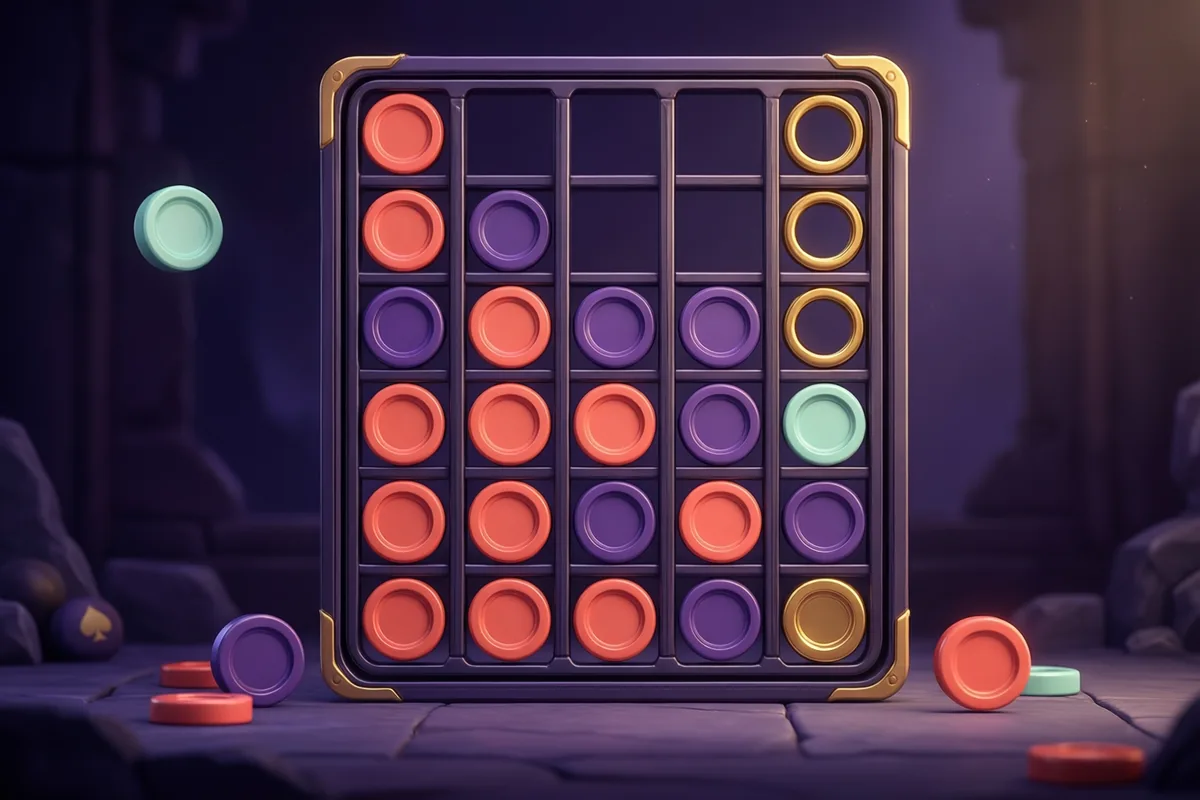 Connect Four
Tap a column / 1–7: drop a disc · Opponent selector: computer or same-device two players · Level selector: easy, normal or hard computer · Undo: take back your last move
Play the computer at Easy, Normal or Hard, or select two players to share the device. Red takes the first turn. Hover a column to preview where your disc lands.
Select one of seven columns. Your disc falls into the lowest empty space; a full column cannot accept another disc.
A horizontal, vertical or diagonal line of four wins immediately. If the board fills without a line, the game is a draw.
This Connect Four game is built for Free Games. Read about controls and local storage.
Check whether a threat has support beneath it before relying on it. In Tic-Tac-Toe, any empty square is available, making it easier to isolate the idea of a fork.
A double threat wins here the same way a fork wins noughts and crosses; the how forks create two threats at once shows how to set up two threats with one move.
Connect Four is Tic-Tac-Toe with gravity, and gravity changes everything. The board stands upright with seven columns and six rows. You do not choose a square, you choose a column, and your disc falls to the lowest free space in it. Four of your discs in a line, horizontal, vertical or diagonal, wins on the spot.
Because you cannot pick the height, every move you make also builds a platform for your opponent. Dropping a disc into a column hands them the square directly above it. Half of good play is refusing to hand over the square that completes their four. The other half is building two threats that sit on playable squares at once, since only one can be blocked. The Connect Four strategy guide works through both ideas with examples.
Play the computer or select 2 players and share the device. Red always moves first. The computer looks several moves ahead and scores the resulting positions, so it will spot your open three and take an easy win of its own, but it is beatable with a plan. If the seven columns feel large, the nine squares of Tic-Tac-Toe teach the same threat arithmetic on a smaller stage.
| Genre | Board Strategy Games |
|---|---|
| Challenge | Easy rules, real depth in the threats |
| Pace | Three to six minutes a game |
| Original era | 1974, published by Milton Bradley |
| Players | Two players on one device, or against the computer |
| Controls | Tap a column / 1–7, Opponent selector, Level selector, Undo |
| Cost | Free, with no account and no download |
The upright four-in-a-row game was sold by Milton Bradley in 1974 under the name Connect Four, and it became one of the most widely owned family games of the following decade. Earlier four-in-a-row games existed on paper and on flat boards, and Milton Bradley's contribution was the standing yellow frame with a slide at the bottom that dropped every disc out at once.
The game has a second life in computer science. In 1988 James Dow Allen and Victor Allis independently solved it, and Allis published the proof in his master's thesis. The result is exact: with perfect play by both sides, the first player wins by moving in the centre column and can force the win on the 41st move at the latest. Any other first move gives the second player at least a draw.
That solution is why the centre column matters so much. It takes part in more possible lines of four than any other column on the board. More two-player boards of this kind are gathered in the board game strategy guide.
Seven columns wide and six rows deep, so 42 spaces in total. A column stops accepting discs once six have landed in it, and the game is a draw if all 42 spaces fill without anyone making a line of four.
Red moves first, and in two-player mode that is whoever takes the first turn. Moving first is a genuine advantage: the game has been solved, and the first player wins with perfect play by starting in the centre column.
No. It sees exactly the board you see and follows the same rules. It searches a few moves ahead and scores the positions it finds, which is why it never misses your open three. Beat it by preparing two threats before either is obvious.
A disc in the centre column can be part of more winning lines than a disc anywhere else, because lines run through it in every direction. Giving up the centre early usually means fighting the rest of the game short of options.
It is counting which row your winning square sits in. Because players alternate and discs stack, a threat on an odd-numbered row tends to fall to the first player and one on an even row to the second. Experienced players plan around that parity.
Yes. Choose 2 players in the opponent selector and pass the device between turns. The board is tappable by column, and the keys 1 to 7 do the same job on a keyboard.
Yes, in both directions, and diagonals are the most commonly missed win in the game. Scan the two diagonals through any square you are about to fill before you commit to a column.
Four games from the same shelf, each with its own pace. The one-line summaries are how their own pages describe them.
| Game | What it is like | Pace | Play |
|---|---|---|---|
| Reversi | Outflank opposing discs and finish with the most discs on an eight-by-eight board. | Around ten minutes a game | Play |
| Tic-Tac-Toe | Make a line of three against the computer or a friend on the same device. | Under a minute per game | Play |
| Chess Clock | Time a game on your own chessboard with two configurable countdown clocks. | Whatever you set, from 1 to 180 minutes | Play |
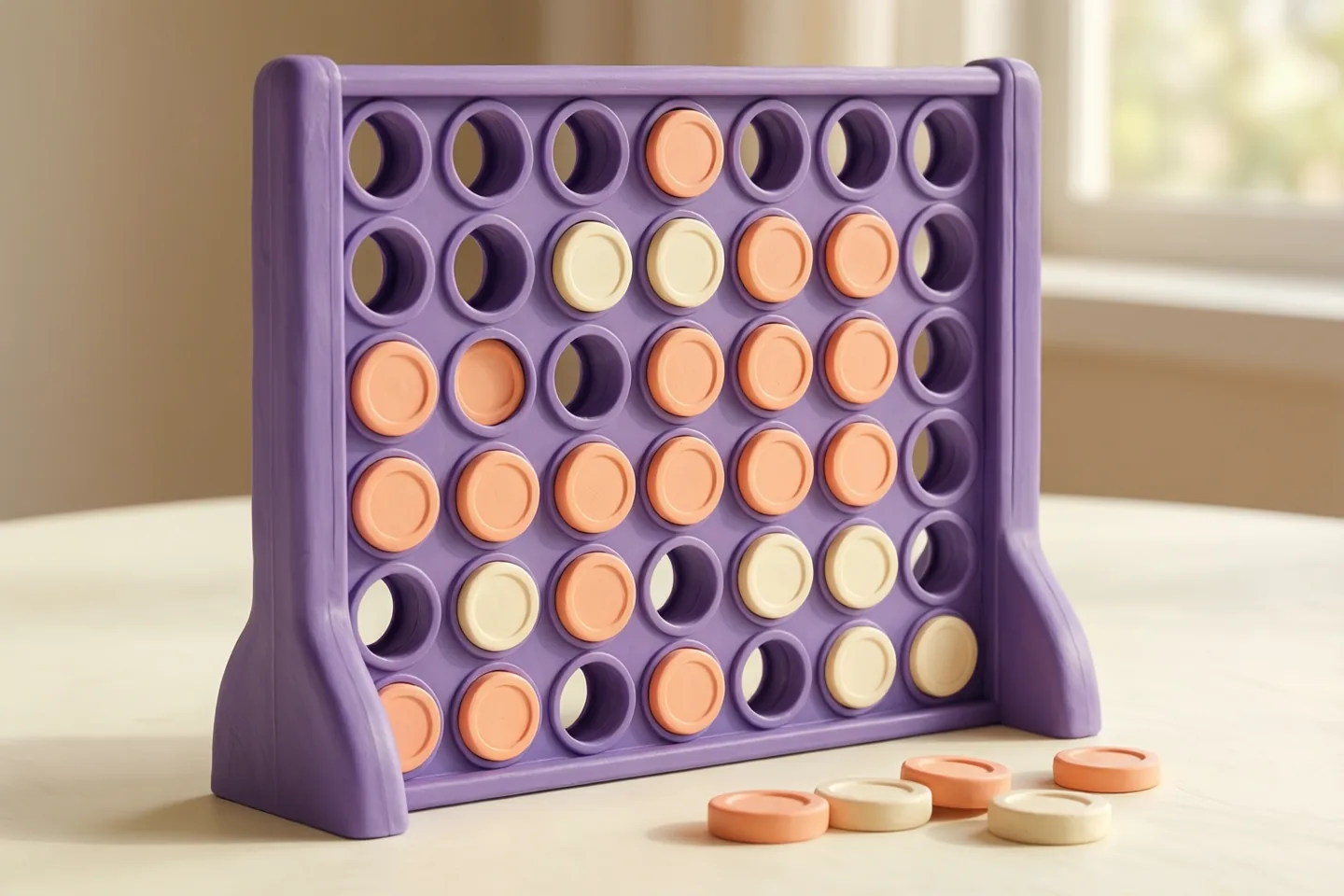
Read gravity, block immediate wins and make use of the center.
NEW GAME

Shortcuts