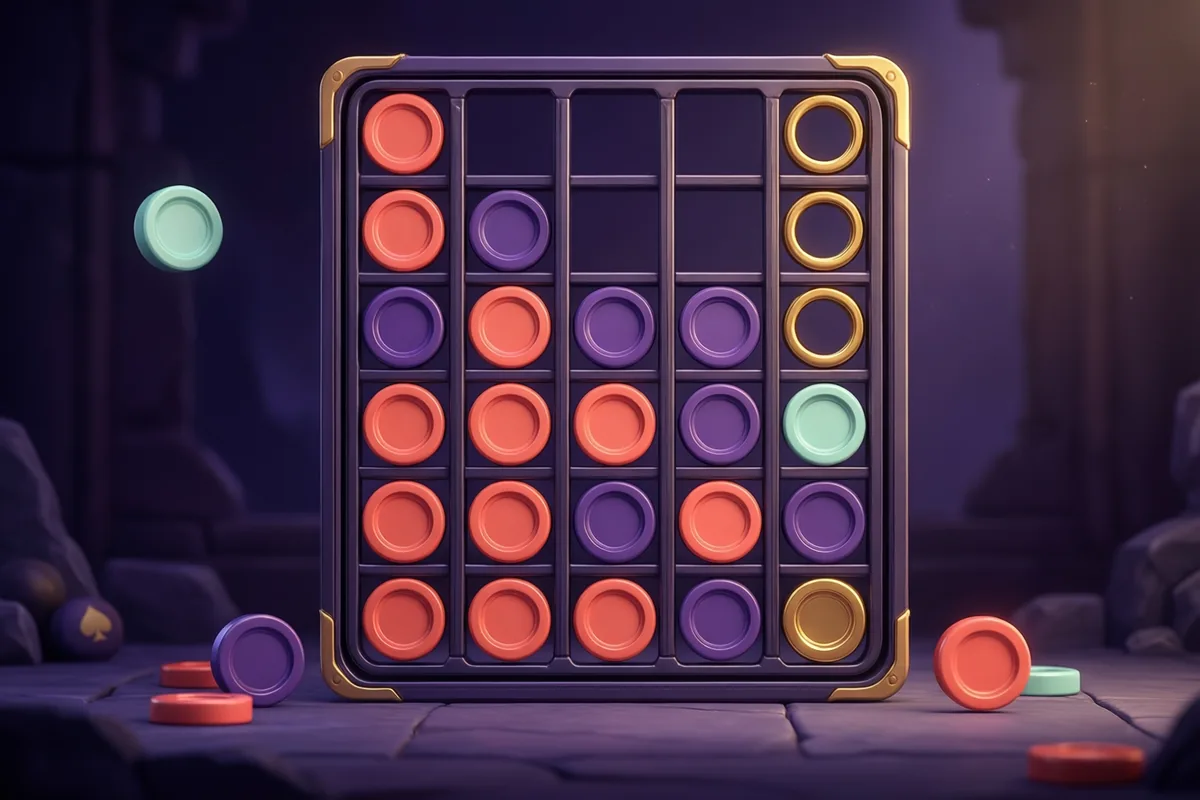
Connect Four: make your threats playable.
Take a winning drop first, then block the opponent’s immediate four. Remember that gravity must support the target square; an apparent threat is useful only when a disc can reach it.
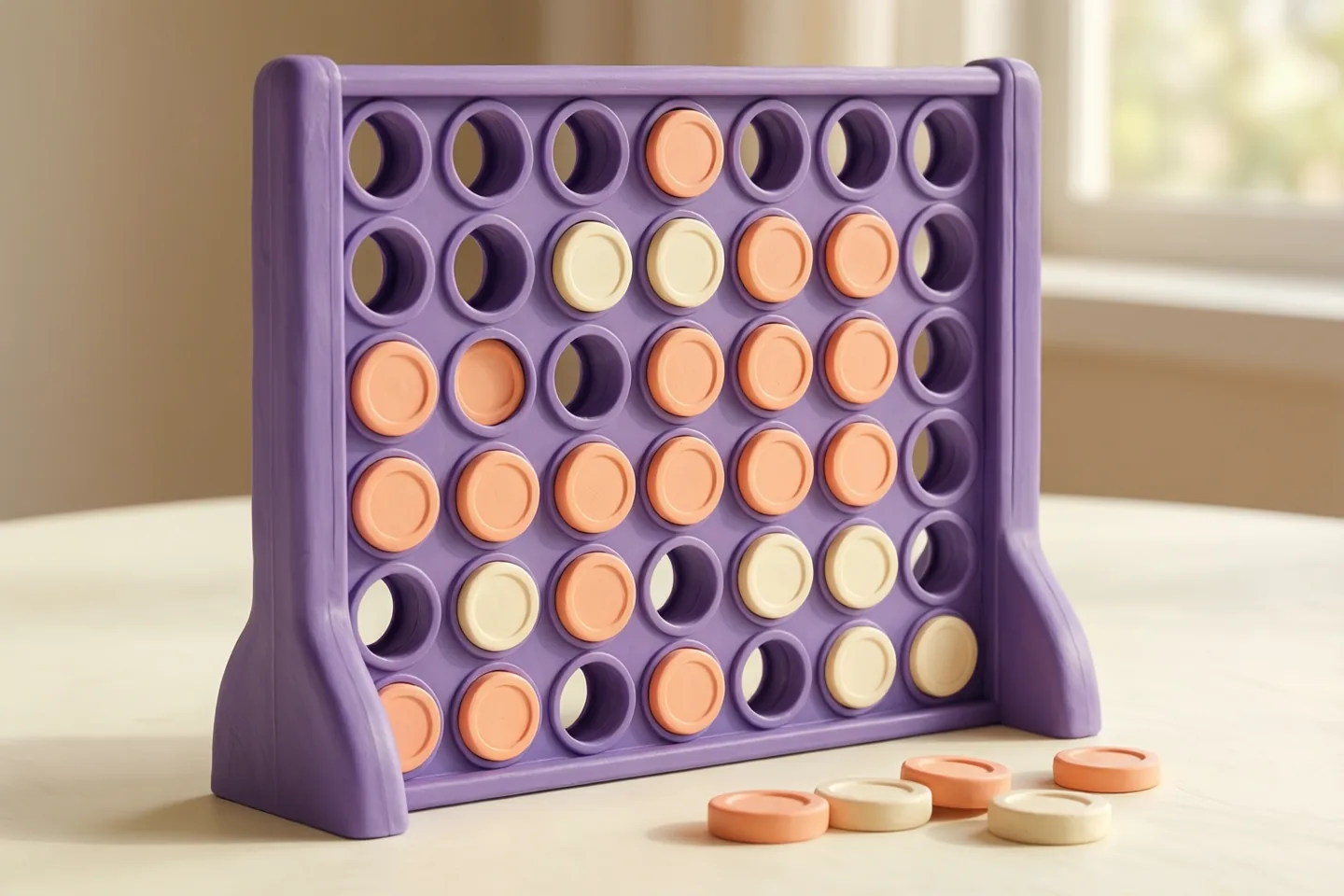
Start with the move that matters most
Look for an immediate win first, then for the opponent’s immediate win, before you build anything.
- Check every column for a move that completes four in a row for you.
- Check every column for a move that would complete four for the opponent, and block it.
- Only then choose a move that improves your position.
Two checks before any plan
Your four first, their four second. Only when both come back empty is it worth thinking about shape and central control.
A diagonal that looks nearly finished may not be playable yet. Discs fall to the lowest empty square, so the support under a winning square matters as much as the square itself.
Use the center without ignoring threats
The central columns participate in many horizontal and diagonal lines. Taking central space gives you options, but it does not outweigh an urgent block. A useful opening keeps several possible directions alive while avoiding a move that lets the opponent finish four on the next turn.
Avoid helping the other player reach a winning square
Before you drop a disc, look at the square directly above it, because that square becomes playable for your opponent.
Gravity makes some helpful-looking moves harmful
If the opponent has three in a diagonal and the fourth square sits above an empty cell, filling that cell supplies exactly the support they need.
Read two squares, not one
Check the square your disc will occupy and the square above it. The second one is what you are handing over.
Every disc you place opens a square
The cell directly above your disc becomes playable immediately. In a column beside a diagonal threat, that single fact is the whole decision.
Build two threats that can actually be played
A Connect Four fork needs two winning squares that can both actually be reached, not two gaps floating high above the filled board.
Threats need support
A winning square is a threat only when the cell beneath it is filled, or about to be. Work backwards from the target square to the moves that supply that support.
Compare it with Tic-Tac-Toe
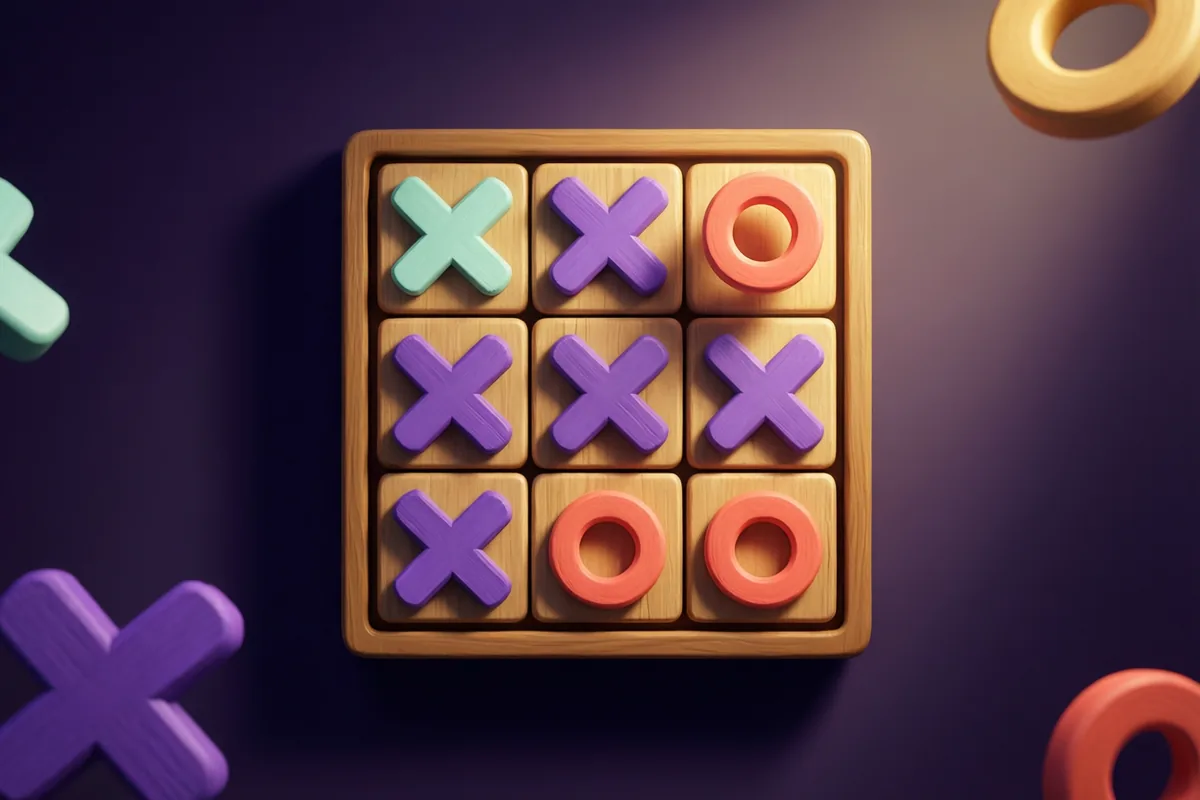
The Tic-Tac-Toe fork lesson shows two threats without gravity. Connect Four adds a second question: when does each threat become playable?
Threats have a schedule
A fork works only when both winning squares become reachable while you still hold the initiative. Count the discs needed to support each one before you commit.
Try both opponent modes
The computer searches several moves ahead and evaluates threats and central control. It is not presented as an unbeatable solver. Choose two players to alternate turns on the same device. The seven arrow buttons above the board also work with a keyboard; keys 1 through 7 choose a column.
Watch a floating threat gain support
V marks Violet, O marks Orange and a dot marks an empty square. Reproduce this position in local mode with columns 1, 2, 2, 3, 4, 3, 3, 4, 7, alternating from Violet. Orange now moves. Rows are numbered from the top.
| Row | A | B | C | D | E | F | G |
|---|---|---|---|---|---|---|---|
| 1 | · | · | · | · | · | · | · |
| 2 | · | · | · | · | · | · | · |
| 3 | · | · | · | · | · | · | · |
| 4 | · | · | V | · | · | · | · |
| 5 | · | V | O | O | · | · | · |
| 6 | V | O | O | V | · | · | V |
| Row | A | B | C | D | E | F | G |
|---|---|---|---|---|---|---|---|
| 1 | · | · | · | · | · | · | · |
| 2 | · | · | · | · | · | · | · |
| 3 | · | · | · | · | · | · | · |
| 4 | · | · | V | O | · | · | · |
| 5 | · | V | O | O | · | · | · |
| 6 | V | O | O | V | · | · | V |
| Row | A | B | C | D | E | F | G |
|---|---|---|---|---|---|---|---|
| 1 | · | · | · | · | · | · | · |
| 2 | · | · | · | · | · | · | · |
| 3 | · | · | · | V | · | · | · |
| 4 | · | · | V | O | · | · | · |
| 5 | · | V | O | O | · | · | · |
| 6 | V | O | O | V | · | · | V |
Initially a disc in column 4 would stop at D4, below the target. Orange’s move supplies that support; Violet can then occupy D3 and join A6, B5 and C4. This shows a defensive mistake, not a forced win from the initial position. Before placing a support disc, inspect the square directly above it.
Check the square before the threat
Open Connect Four for a playable example from this collection, then continue with the Reversi strategy guide. Browse the board strategy games collection as more games are added to the public library.
Questions about connect four
Is Connect Four a solved game?
Yes. Mathematicians solved the standard seven by six board in 1988, and with perfect play from both sides the first player wins by starting in the middle column. That result does not describe the computer here, which searches several moves ahead rather than playing a solved line, so it can be beaten.
How do I beat the computer opponent?
Make it answer threats instead of building its own. Check for your win, then its win, then play a move that creates a new threat it must respond to. The computer looks a few moves ahead, so a plan that only pays off much later usually gets dismantled first.
What single mistake loses most beginner games?
Dropping a disc directly below a square the opponent needs. Your move fills the support, and their winning square becomes playable on the next turn. Before you place a disc, look at the square immediately above it and ask who it helps.
Should I attack or block when I can only do one?
Block, unless your own move wins immediately. A completed four ends the game at once, so an actual win always beats a threat, but anything short of that loses to their completed four first. Check for your own winning column before deciding you are on the defensive.
These tips refer to the editions in our library. Game controls and behavior can differ elsewhere. Spotted a problem?