Reversi: the biggest capture can wait.
Choose a legal move that brackets opposing discs. Corners stay secure once occupied, while access to legal replies can matter more than taking many discs immediately. A blocked player passes automatically.
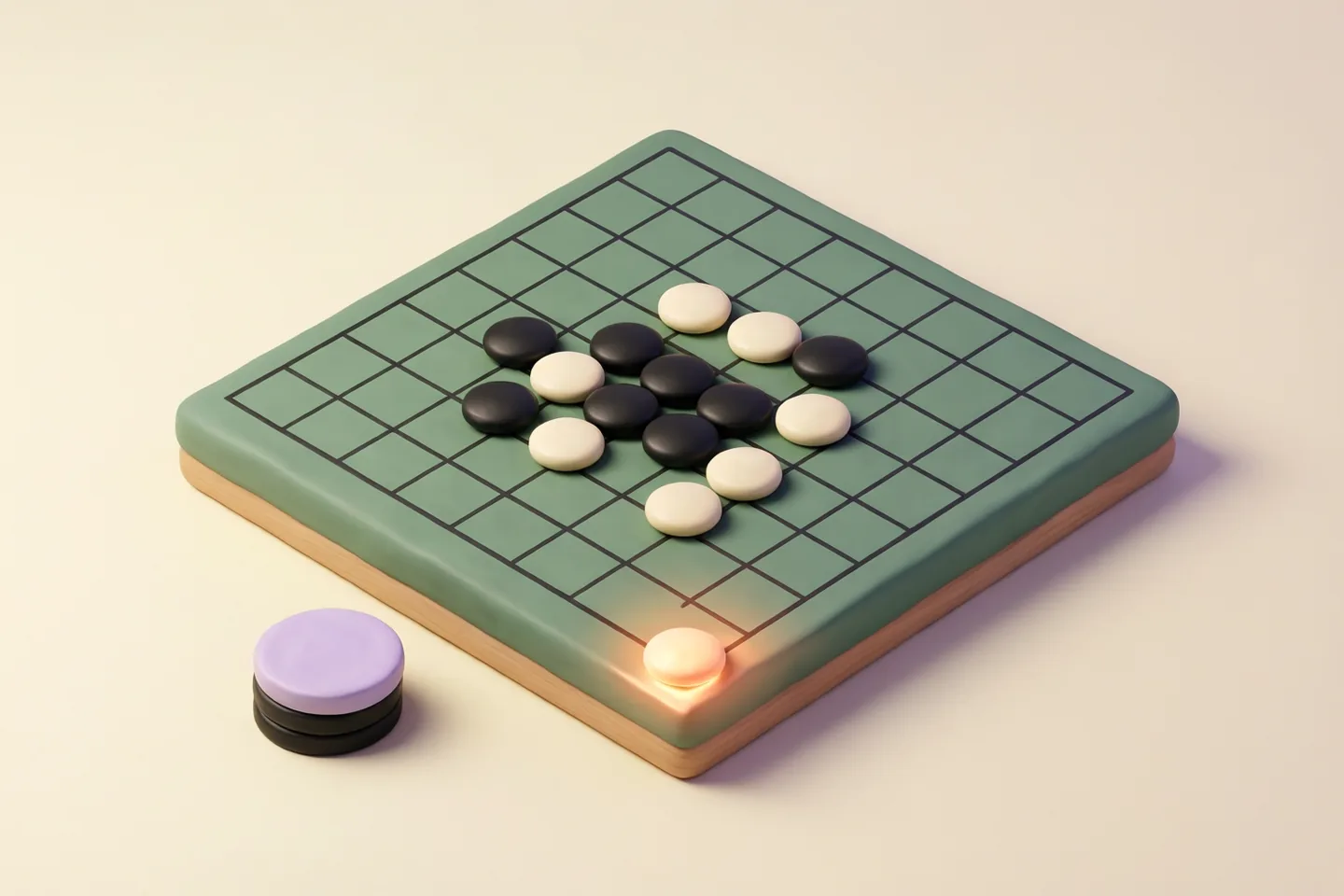
Look for a bracket in every direction
A legal Reversi move traps an unbroken line of opposing discs between the disc you place and one of your own.
Lines run in eight directions
Horizontal, vertical and diagonal lines all count. Check each direction outward from the square you are considering.
A gap breaks the bracket
One empty square anywhere in the line cancels it. The trapped discs must be continuous and must all belong to the opponent.
Every bracket flips
When a placement brackets in more than one direction, all of those lines flip. Flipping only one of them is not an option.
Check all eight directions each turn
It is easy to spot one bracket and miss another running from the same square. Scanning outward in all eight directions also shows how many discs the move would flip.
Count choices as well as discs
An early move that takes many discs may leave the other player with several strong replies. Mobility means the number of legal moves a player has. Try to keep useful choices for your next turn while reducing the opponent’s options. This is one reason a small early disc total is not necessarily a losing position.
Treat empty corners carefully
A corner disc can never be flipped, because no line can surround it from both sides.
- A corner is permanent once taken, so it anchors the discs beside it.
- The squares next to an empty corner can hand the opponent a bracket that ends in that corner.
- Treat those squares as decisions rather than ordinary edge moves.
- Check the position that results instead of assuming every edge square is equally safe.
Corners anchor the edge beside them
A line running out from a corner you own cannot be bracketed from the corner end, so those discs are much harder to take back. That is what makes a corner worth more than its single disc.
Mobility and corners work together
Reducing the opponent’s legal moves can force them to play next to a corner. That is a more reliable route to a corner than taking discs quickly.
Against the computer you play Black, and marked squares show the moves available to you.
Understand passes and the finish
A Reversi player with no legal placement must pass. The game ends when neither player can move, even if empty squares remain.
- One player cannot move: this edition passes that turn automatically and announces it.
- Neither player can move: count the discs remaining on the board.
- More discs wins; equal totals produce a draw.
Practice a specific decision
Play a round focusing on corner access, then a round where you count the opponent’s legal replies before each move. Against the computer, you play Black. The two-player option uses the same device. Marked squares show available moves so you can concentrate on choosing among them.
Compare captures and legal replies on one board
B means Black, W means White and a dot means empty. Starting from the normal opening, play F5, F4, D3, F6, G3, C3 in local mode. Black now chooses between G5 and C4. Rows run from top to bottom.
| Row | A | B | C | D | E | F | G | H |
|---|---|---|---|---|---|---|---|---|
| 1 | · | · | · | · | · | · | · | · |
| 2 | · | · | · | · | · | · | · | · |
| 3 | · | · | W | B | · | · | B | · |
| 4 | · | · | · | W | B | B | · | · |
| 5 | · | · | · | B | W | W | · | · |
| 6 | · | · | · | · | · | W | · | · |
| 7 | · | · | · | · | · | · | · | · |
| 8 | · | · | · | · | · | · | · | · |
| Row | A | B | C | D | E | F | G | H |
|---|---|---|---|---|---|---|---|---|
| 1 | · | · | · | · | · | · | · | · |
| 2 | · | · | · | · | · | · | · | · |
| 3 | · | · | W | B | · | · | B | · |
| 4 | · | · | · | W | B | B | · | · |
| 5 | · | · | · | B | B | B | B | · |
| 6 | · | · | · | · | · | W | · | · |
| 7 | · | · | · | · | · | · | · | · |
| 8 | · | · | · | · | · | · | · | · |
| Row | A | B | C | D | E | F | G | H |
|---|---|---|---|---|---|---|---|---|
| 1 | · | · | · | · | · | · | · | · |
| 2 | · | · | · | · | · | · | · | · |
| 3 | · | · | W | B | · | · | B | · |
| 4 | · | · | B | B | B | B | · | · |
| 5 | · | · | · | B | W | W | · | · |
| 6 | · | · | · | · | · | W | · | · |
| 7 | · | · | · | · | · | · | · | · |
| 8 | · | · | · | · | · | · | · | · |
| Black move | Flipped discs | White replies |
|---|---|---|
| G5 | 2 | D2, E3, F3, G4, H4, D6 |
| C4 | 1 | C2, H2, E3, F3, C5 |
G5 takes more discs immediately and also leaves White more choices. This is a mobility comparison, not proof that C4 is the best move or guarantees a win. Compare the quality of those replies before choosing; a legal-move count alone does not settle the position.
Count legal replies on the board
Open Reversi for a playable example from this collection, then continue with the logic puzzle comparison. Browse the board strategy games collection as more games are added to the public library.
Questions about reversi
Is there a good opening move in Reversi?
All four opening moves are the same by symmetry, so the first move cannot be wrong. What matters is the next few, where taking many discs early usually hands the opponent more good replies. Judge an opening by the choices it leaves you, not by the count on the board.
What do I do when every move I have looks bad?
Play the one that gives away the least, and prefer a move that does not open a path to an empty corner. A position with few options is normal in the middle of a game and is often recoverable, since discs flip back. Count the replies your move gives the opponent before picking the one that flips the most.
Does it matter whether I play Black or White?
Black moves first, and against the computer here you always play Black. Going first means you set the shape of the opening, though in Reversi that is a smaller advantage than it sounds, because every disc on the board can change colour. Marked squares show your legal moves either way.
How long does a full game take?
At most sixty placements, because the board holds sixty-four squares and four discs are already there at the start. Games often end sooner, since play stops as soon as neither player has a legal move, even with empty squares left. That makes a full game short enough to replay a decision you were unsure about.
These tips refer to the editions in our library. Game controls and behavior can differ elsewhere. Spotted a problem?