Mancala Kalah: count the landing stone.
In Kalah, sow from your side and skip the opponent’s store. Landing in your store earns another turn. Landing in an empty own pit captures an occupied opposite pit; when one side empties, sweep and compare stores.
Know which Mancala you are playing
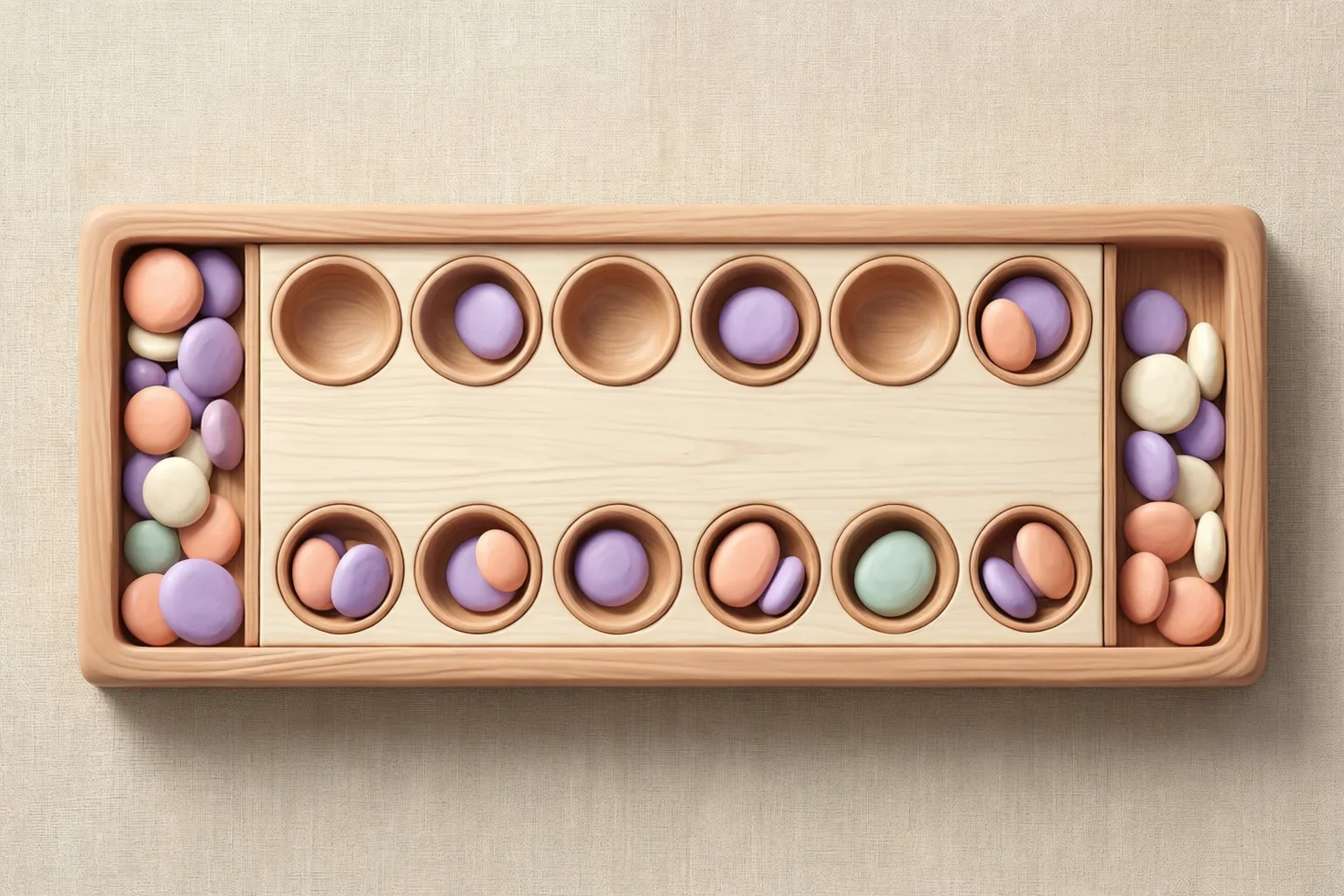
Mancala describes a family of games. This site implements Kalah with six pits per side and four stones in every starting pit. Violet uses the bottom row and the store on the right; Orange uses the top row and the store on the left. Choose a pit on your side to sow its stones counterclockwise, one at a time. Your own store receives stones, while the opponent’s store is skipped.
Count before you sow
Violet’s third pit from the left earns another turn from the opening Kalah position because its fourth stone lands in the store.
- Pick up the four stones in the third pit of the bottom row.
- Put one stone in each of the fourth, fifth and sixth pits.
- Place the fourth stone in your store on the right.
- Take another turn, then recount the changed pits before choosing again.
A large pit can carry stones around the board. Skip the opponent’s store when tracing that route. This example describes the opening position, not a move that always earns another turn.
Watch empty pits as carefully as full ones
If your last stone lands in an empty pit on your own side, you capture the stones directly opposite along with that landing stone.
The opposite pit must hold stones
An empty pit facing an empty pit captures nothing. Check both sides before treating the landing as a capture.
The landing stone goes to the store too
The captured pile includes the stone you just placed, so a capture is always one stone more than the opposite pit holds.
Your empty pits are your opponent’s chance
The same rule works against you. Before sowing, check whether your move leaves the opponent a landing square opposite one of your full pits.
Look at both rows before sowing
A capture depends on a pit on your side and the pit facing it across the board. Reading only your own row hides half of the position.
Emptying a pit is neither good nor bad by itself. Its position relative to the next sowing sequence decides the threat.
Plan the final sweep
The game ends as soon as one side has no stones in its six pits, and the other player sweeps their remaining stones into their own store.
- All 48 stones finish in the two stores, and the larger store wins.
- A move that empties your row can lose if it hands the opponent a large final sweep.
- Near the end, count the stores plus the possible sweep, not only the stones you collect now.
- Two-player mode makes these endgame counts easy to work through on one device.
The sweep can decide the game
Stones left on the board at the end are not wasted; they go to whoever still holds them. A row you empty on purpose can hand the opponent a large final collection.
Count stores, not turns
Near the end, add your store to the stones you could still expect to sweep. That total, rather than the number of moves left, tells you who is ahead.
See where the four opening stones land
Violet is the bottom player and sows from the third pit from the left. The tables show pits in screen order; the top row is reversed relative to the sowing direction.
| Row | Pit 1 | Pit 2 | Pit 3 | Pit 4 | Pit 5 | Pit 6 |
|---|---|---|---|---|---|---|
| 1 | 4 | 4 | 0 | 5 | 5 | 5 |
| State | Orange pits, left to right | Violet pits, left to right | Violet store |
|---|---|---|---|
| Before | 4, 4, 4, 4, 4, 4 | 4, 4, 4, 4, 4, 4 | 0 |
| After | 4, 4, 4, 4, 4, 4 | 4, 4, 0, 5, 5, 5 | 1 |
The four destinations are pit 4, pit 5, pit 6 and Violet’s right-hand store. The store becomes 1 and Orange’s store stays 0. Because the last stone lands in Violet’s store, Violet moves again. All 48 stones remain on the board and in the stores.
Count the landing stone on the board
Open Tic-Tac-Toe for a playable example from this collection, then continue with the Dots and Boxes chain guide. Browse the board strategy games collection as more games are added to the public library.
Questions about mancala kalah
How many stones are on the board altogether?
Forty-eight. Twelve pits start with four stones each, and the two stores start empty. Every stone stays in play, so the two stores always add up to forty-eight at the end and the larger store wins.
Is Mancala mostly luck?
No. There is no dice roll, no shuffle and no hidden information, so both players can see everything and count it. The result comes down to whether you traced the sowing before you picked a pit.
Can I take several extra turns in a row?
Yes. Any sowing whose last stone lands in your own store gives you another turn, and there is no limit on how many times that can happen in succession. Recount the pits after each one, because your own sowing has just changed the board you were reading.
Does the player who goes first have an advantage?
The first player does get to set up the opening, and from the starting position the third pit from the left ends its fourth stone in the store and earns an immediate extra turn. That is one free move, not a won game. The second player sees the whole board and can plan around the capture threats it creates.
These tips refer to the editions in our library. Game controls and behavior can differ elsewhere. Spotted a problem?