Mini Putt: make the next shot easier.
Plan a clear route to the hole or a useful landing position. Start with controlled power; if the direction is right but the shot is short, adjust only the power on the next putt.
Start with the opening lane
Hole one is a straight lane with the ball and cup aligned, which makes it the place to learn power.
- Drag downward from the ball and release; the shot travels opposite the drag.
- A longer drag adds power, up to a cap.
- Watch how fast the ball reaches the cup.
- If it rolls straight over, use less power rather than a different line.
Power is a separate skill from line
Hole one removes the line problem so you can study power on its own. Play it a few times and watch how fast the ball is travelling when it reaches the cup.
Drag away from where you want to go
The ball travels opposite your drag, so a downward drag sends it up the lane. Power rises with drag length up to a cap, beyond which a longer drag changes nothing.
Learn the speed at the cup
The useful memory from hole one is not the drag length but how the ball looked as it reached the cup. That picture transfers to holes with obstacles.
The cup only accepts a ball arriving slowly enough to drop. A short follow-up putt often beats another full-power attempt from the far end.
Change the route when the course blocks it
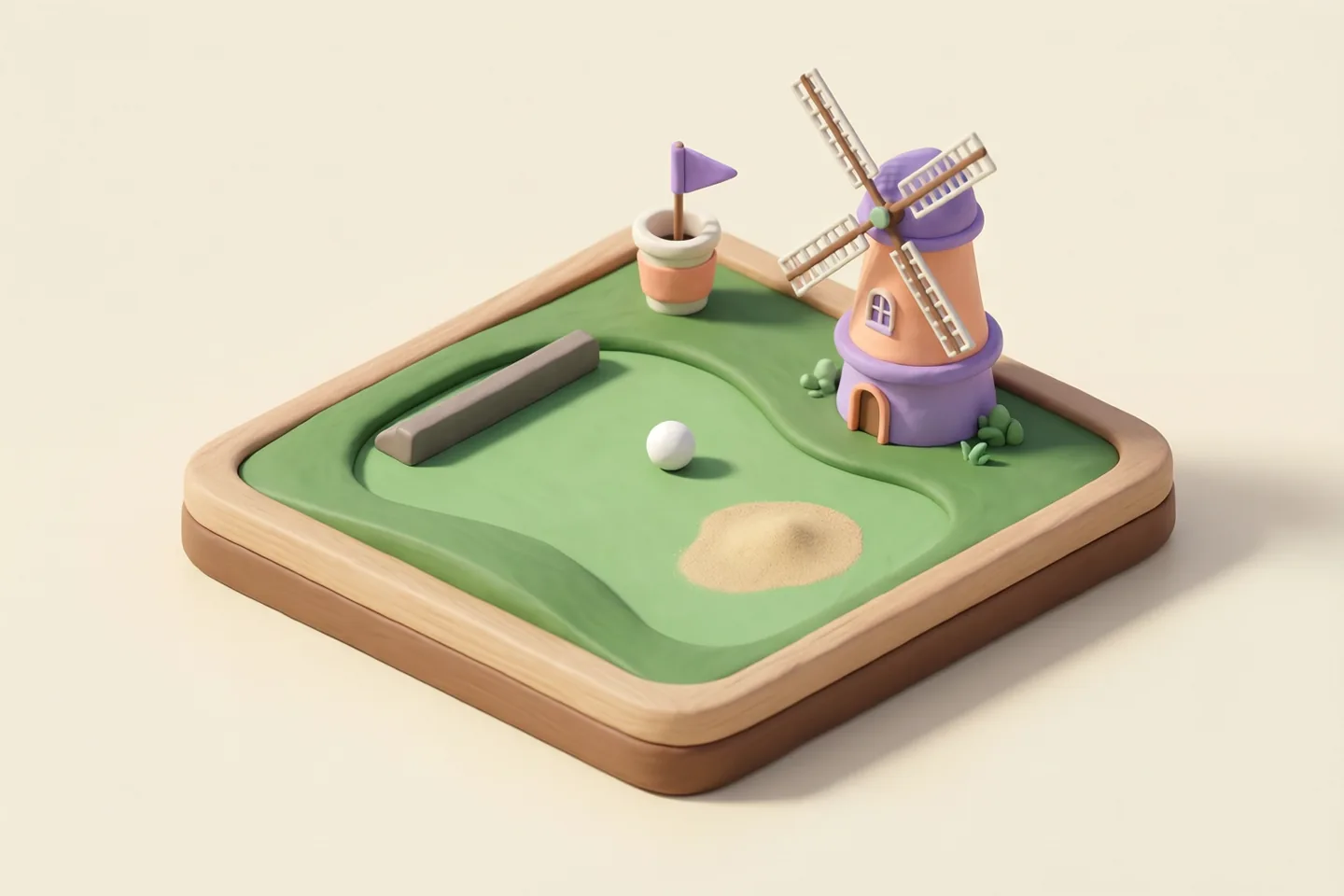
Hole two places a rectangular block directly between the starting ball and the cup. Repeating the straight shot from hole one drives into that obstacle. Choose a side route, then leave a position with a clear approach beyond the block. Hole three turns through an L-shaped corridor, so inspect where the ball can stop near the bend. These holes require a changed route, not simply more power on the original line.
Account for sand and the windmill
Sand and the windmill both change what a familiar drag length does.
Hole five, The Beach
A band of sand crosses the lane, and the ball slows more quickly there than on grass. The power that worked on hole one no longer covers the same distance.
Hole six, The Windmill
A rotating blade crosses the approach. Watch its motion and leave the ball time to reach the opening, because the blade can deflect a ball that is already rolling.
Treat the two hazards separately
They fail for different reasons. Sand drains power, while the windmill blocks the line at the wrong moment. One asks for more power, the other for better timing.
Plan the stopping point, not the hole
On a hazard hole, aim for a spot with a clear approach rather than the cup itself. Two controlled strokes through sand usually beat one hopeful full-power putt.
Read the windmill before you release
The blade keeps turning while the ball rolls, so the gap you can see at release is not the gap the ball will meet. Allow for the travel time down the lane.
Read the course result correctly
The nine holes total par 26, so compare your strokes with par rather than reading the points display as a score.
| Hole | Name | Par |
|---|---|---|
| 1 | The Warm-Up | 2 |
| 2 | Center Block | 2 |
| 3 | The L | 3 |
| 4 | Corner Bumpers | 2 |
| 5 | The Beach | 3 |
| 6 | The Windmill | 3 |
| 7 | The Zigzag | 4 |
| 8 | The Funnel | 3 |
| 9 | The Gauntlet | 4 |
Par is the yardstick
The card totals 26 across nine holes, so comparing each hole with its par shows where you are losing strokes. The points display rewards other things and will not show you that.
Eight strokes and the hole moves on
If you have not holed out after eight strokes, the game picks the ball up once it stops and advances the course. Counting that as a completed hole flatters your card.
Compare holes, not runs
A course result is nine separate problems. Reading it hole by hole against par shows you which two or three are costing you the round.
After eight unsuccessful strokes on a hole, the game picks the ball up and moves on once it stops. That is not a holed putt.
Make the next putt informative
Open Mini Putt for a playable example from this collection, then continue with the Tic-Tac-Toe fork guide. Browse the arcade sports games collection as more games are added to the public library.
Questions about mini putt
Should I aim at the cup or at a safe spot?
Aim at the cup only when a clear line exists and the ball can arrive slowly. Otherwise, play to a spot that leaves an easy next putt, which is what keeps a hole at par. A ball that rolls over the cup at speed does not drop, so pace matters as much as line.
Why does my ball stop short of the hole so often?
Because the drag length that worked on an open green does not survive the surface in between. Sand slows the ball far more quickly than grass does, so a putt crossing it needs noticeably more power. Watch where the ball loses speed, then change the power rather than the line.
Is Mini Putt more about power or angle?
Power on the straight holes and angle on the shaped ones. Hole one lines the ball up with the cup so you can learn what a drag length does, while hole two puts a block in the way and needs a route rather than more force. Once a hole bends, the correct power depends on the line you have chosen.
Can I replay a single hole I made a mess of?
No. The card records what you scored and the game advances to the next hole, and Restart begins a new round from hole one. Since the nine holes total par twenty-six, one bad hole is recoverable, so play on rather than restarting.
These tips refer to the editions in our library. Game controls and behavior can differ elsewhere. Spotted a problem?