
Bloons Tower DefenseSkill·Free to play
 Free-Games.toSign inSurprise me
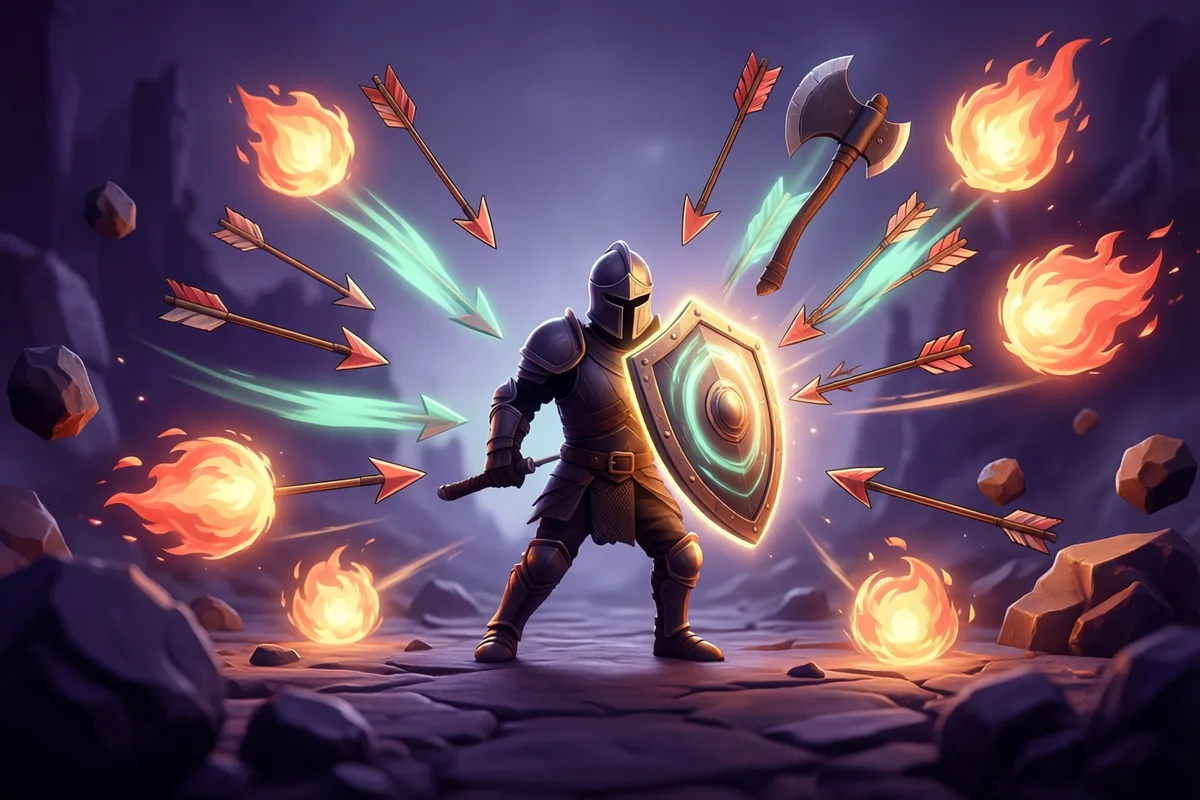
Spin your shield around the hero to block waves of arrows, axes, fireballs, boulders, spears and magic orbs from every direction.
Sign in to save your scores and play history, or keep playing as a guest. Recent game activity and scores appear on the homepage with a masked email or IP address.
 Shield Defense
Move your mouse (or drag a finger) and the shield swings to face that direction. On keyboard, ← and → rotate it around the hero. The shield is an arc - It covers a slice, never the circle.
Anything that touches the shield deflects harmlessly away and pays points. Anything that slips past the arc hits the knight and costs a heart.
Catch a projectile on the very center of the shield and the block is PERFECT, doubling its points. Centering your blocks is the whole difference between good runs and great ones.
Volleys arrive three-in-a-row from one side; pincers come from opposite sides almost at once. Spot which one is forming and your shield can be waiting instead of chasing.
Every few waves a heart drifts across the arena. Touch it with the shield or the knight to heal one heart, up to four - But never trade a block for it.
This is our browser edition, adapted from ARCADENOW. Its artwork, tuning and controls may differ from other games with similar rules. Guest personal bests stay in this browser. Signed-in players can also save scores and play history to their private dashboard; there is no global leaderboard. Read about controls and local storage.
Your shield responds to the direction of each attack. Bloons Tower Defense moves the defensive decision earlier, asking you to place towers before balloons travel along their route.
Shield Defense strips the action game down to its most stubborn idea: you don't get a sword. Your knight stands in the middle of a torchlit arena while the world throws things at him - Arrows first, then spinning axes, then fireballs that arrive faster than gratitude, then boulders with your name on them. Your only verb is the shield: a steel arc you swing around your body with the mouse, a finger, or the arrow keys, catching each attack before it lands. Every block scores, consecutive blocks build a combo, and a dead-center PERFECT block pays double - The difference between surviving a wave and profiting from one. Attacks come in volleys from one side and pincers from two at once, waves grow denser and faster forever, and a stray heart drifts through the arena every few waves for knights who can spare the attention. Three hearts, no healing potions, no mercy - Just you, the shield, and increasingly personal geometry. Every run fires a fresh barrage at you, so the wave you reached last time is the only mark that means anything.
| Genre | Browser Skill Games |
|---|---|
| Challenge | 360 degrees of trouble |
| Pace | Denser volleys every wave |
| Original era | 2015 (arena-defense era) |
| Players | Single player |
| Controls | Mouse / drag, ← → |
| Cost | Free, with no account and no download |
Games about defense are as old as games about attack, but they were usually about walls: Missile Command (1980) made you guardian of six cities, and the tower-defense boom of the 2000s turned protection into architecture. The rarer, purer branch gives you no wall at all - Just a single guard input and escalating incoming fire. Arcade history keeps rediscovering it, from bat-and-shield electromechanical cabinets to the parry timing that anchors entire modern genres.
The direct ancestors of Shield Defense are the one-mechanic arena defenders of the browser and mobile era - Games where a paddle, orbiting blocker or rotating barrier is your whole toolkit and the projectiles arrive from all 360 degrees. That format hit its stride in the mid-2010s: easy to touch-control, brutal to master, and endlessly fair, because every death is legibly your own aim. Layer on the fighting-game lineage of the perfect parry - The reward for blocking not just correctly but exactly - And you have this game's entire family tree.
Shield Defense distills all of it into one knight and one arc of steel: typed projectiles with honest speeds, volleys and pincers instead of random spam, combos for consistency and PERFECTs for precision, and a barrage that composes itself anew every single run. No sword. The shield is the hero - It's in the name.
Each block pays by projectile type - Arrows 10, axes 15, fireballs 20, boulders 25 - Plus a growing combo bonus for consecutive blocks. PERFECT center blocks double the whole payout, and clearing a wave banks a bonus on top.
Catching the projectile within the narrow dead-center of the shield arc. You will feel it: the hit lands on the shield boss instead of the rim, the score doubles, and the arena briefly approves of you.
Three hearts, with a fourth possible via drifting heart pickups. Each hit grants a moment of invulnerability, resets your combo, and shakes the arena to remind you whose fault it was.
No - They get denser, faster and more mixed forever, exactly like the arcade intended. Every run ends eventually; your score measures how far you pushed the storm.
Arrows are fast and cheap, axes tumble in slower but heavier, fireballs are the fastest thing in the arena, and boulders are slow, huge and worth the most - A mixed volley forces you to block them in arrival order, not spawn order.
No. The knight holds the center like a professional; only the shield moves. Shield Defense is a pure aiming and prioritization game - That constraint is the game.
No. Spawn angles, projectile types and volley patterns are rolled fresh each run, so shieldcraft has to be read in the moment rather than rehearsed.
Drag your finger around the knight and the shield follows it. Most touch players keep a thumb resting near the hero and roll it around the dial - The arena was tuned for exactly that grip.
Four games from the same shelf, each with its own pace. The one-line summaries are how their own pages describe them.
| Game | What it is like | Pace | Play |
|---|---|---|---|
| Bloons Tower Defense | They only need one gap in your defense. | Waves with breathing room | Play |
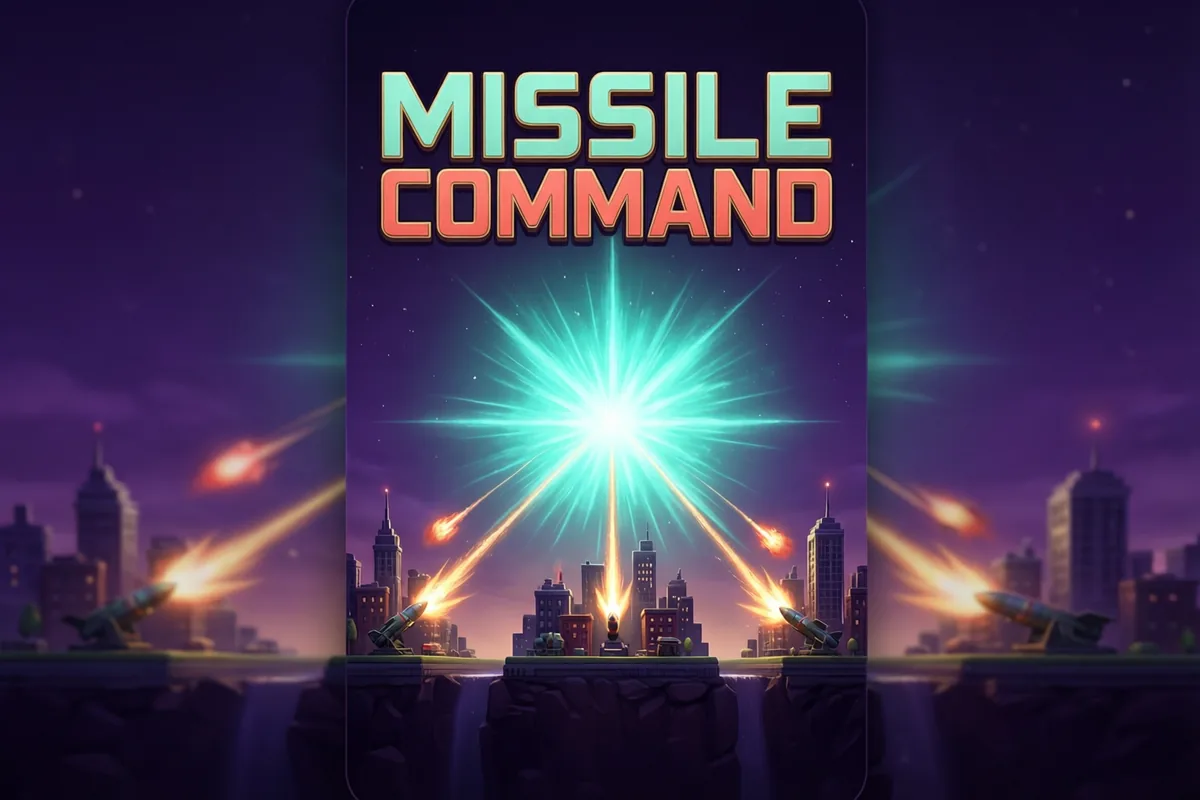
| Missile Command | Six cities, three silos, and a sky full of trouble. | Waves escalate fast | Play |
Separate anticipation, reaction and continuous steering so you can tell what an attempt actually teaches.
Shortcuts