
Bloons Tower DefenseSkill·Free to play
 Free-Games.toSign inSurprise me
Detonate counter-missiles in the path of incoming warheads to save your cities.
Independent browser adaptation · Not an official releaseSign in to save your scores and play history, or keep playing as a guest. Recent game activity and scores appear on the homepage with a masked email or IP address.
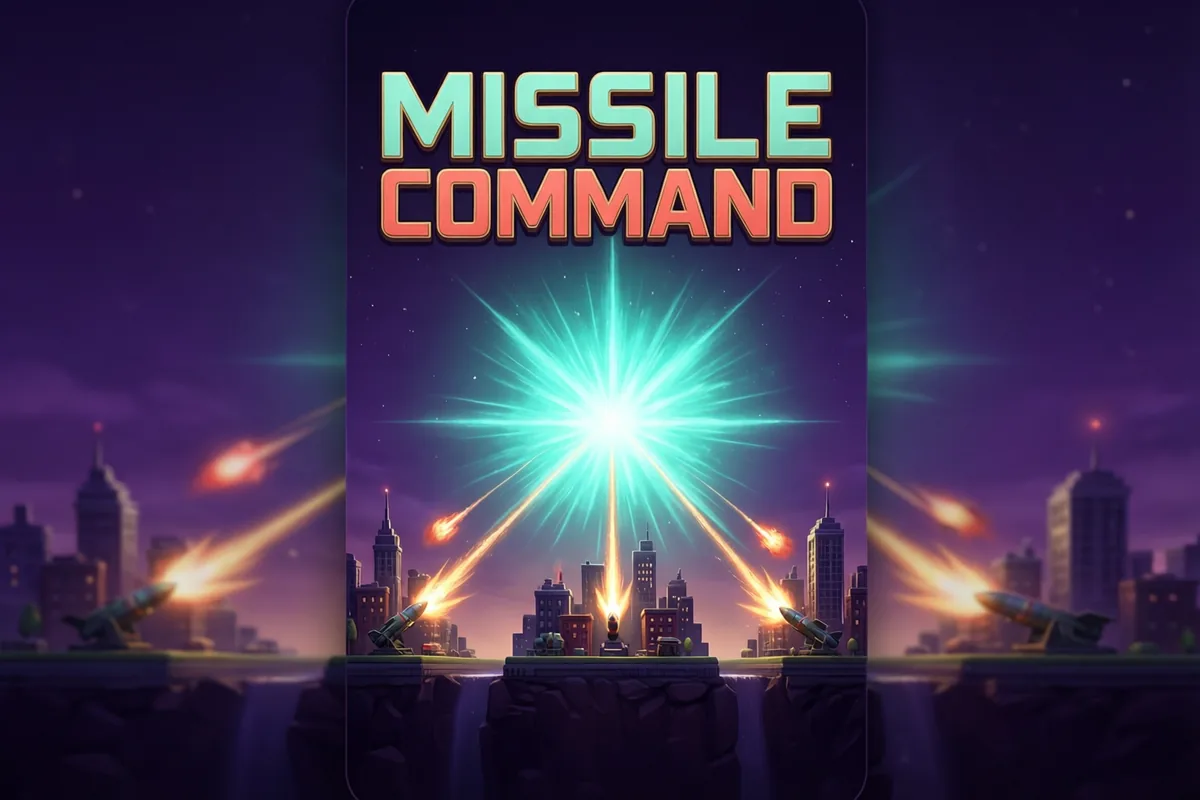 Missile Command
Move the crosshair with your mouse or finger, then click or tap to launch. Your counter-missile flies to that exact point and detonates there - The expanding blast is what does the destroying.
Enemy missiles crawl down straight, predictable trails. Put your explosion on the trail a beat ahead of the warhead and let it fly into the fireball on its own.
You command three silos - Left, center, and right - Each with its own limited stock. Press 1, 2, or 3 to choose, and remember the center silo's missiles fly fastest for emergencies.
Warheads target both. A hit city is rubble for the rest of the run, and a hit silo takes all of its remaining ammo with it. Losing your launchers hurts as much as losing what they protect.
When the sky finally clears, you score bonus points for every unused missile and every standing city, then a fiercer wave begins. The run ends only when all six cities are gone.
This independent browser adaptation uses the original game’s established title. It is not an official publisher release or an original ROM. Its artwork, tuning and controls may differ from other games with similar rules. Guest personal bests stay in this browser. Signed-in players can also save scores and play history to their private dashboard; there is no global leaderboard. Read about controls and local storage.
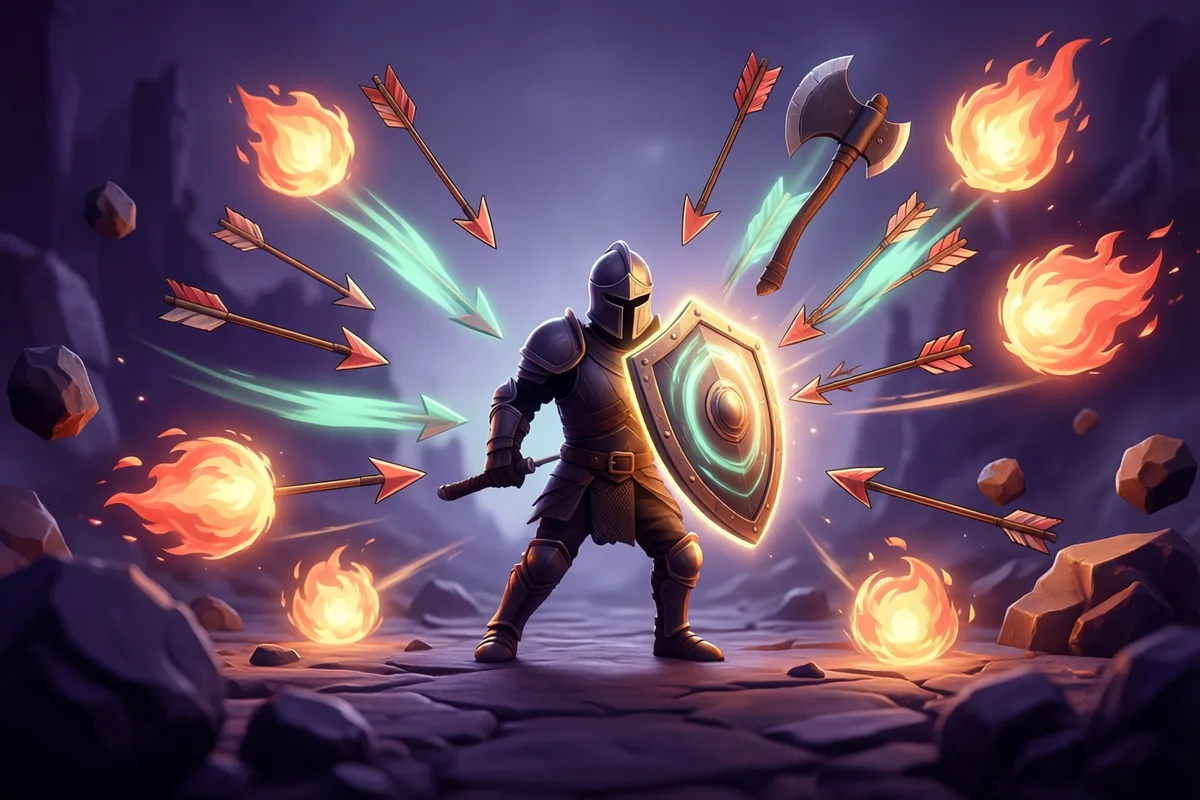
An interception works only if it meets the incoming path in time. Shield Defense brings that defensive decision close to the character: rotate a shield toward the next threat.
Missile Command puts you on the last line of defense: six cities, three missile silos, and a night sky slowly unzipping with enemy warheads. You never shoot the missiles directly - You aim at a point in the sky, launch, and leave a blossom of explosion exactly where a warhead is about to be. Every intercept is a small prediction. Ammo is limited, silos can be blasted into silence, and smart bombs jink around your fireballs like they have read your plan. Between waves you count survivors, because cities lost here stay lost. The 1980 original ran on a trackball; our version maps that same sweep to your mouse or fingertip, so aiming feels instant instead of retro. Hold out through the endless waves, each one raining down on a fresh set of trajectories, and see whether your cities outlast the ones you saved last time.
| Genre | Arcade Shooting Games |
|---|---|
| Challenge | Aim where they will be, not where they are |
| Pace | Waves escalate fast |
| Original era | 1980 (Atari) |
| Players | Single player |
| Controls | Mouse / Tap, Arrows + Space, 1 2 3, Blast a crate |
| Cost | Free, with no account and no download |
Missile Command was designed in 1980 by Dave Theurer at Atari, from a brief inspired by a magazine piece about radar and satellite defense. Built at the height of Cold War dread - Its working title was Armageddon, and its six cities were modeled on the California coast - The game gave players a trackball, three silos, and a defense that could never fully succeed. The project marked Theurer deeply: he described recurring nightmares of missile trails descending over real cities.
That anxiety is exactly why it worked. Missile Command became one of the biggest hits of the arcade's golden age, and its refusal to say 'Game Over' - ending instead on a screen-filling blast and the words 'The End' - Made it the rare quarter-muncher with a message. Rob Fulop's 1981 Atari 2600 port compressed the three silos into one and still sold over two and a half million cartridges.
Four decades on, the design needs no translation: aim, predict, protect, lose a little every wave. Our browser version swaps the trackball for your mouse or fingertip, keeps the limited ammo and the chain explosions, and saves your best defence - So the question is no longer whether the sky falls, but how long you hold out when it does.
No - You detonate explosions in their path. Your counter-missile blows up wherever you aimed, and any warhead that touches the expanding fireball is destroyed. It is area denial, not sharpshooting.
Late-wave weapons that swerve around the edges of your explosions. They have to be destroyed with a blast placed almost exactly on top of them, which makes them the biggest ammo drain in the game.
Each of your three silos carries ten missiles per wave - Thirty total, and not one more until the wave ends. A silo flashes a low warning when it is nearly dry.
Yes, one way only: every 10,000 points earns a bonus city, which rebuilds one ruin at the start of a later wave. Big scores are also your repair budget.
Those are MIRVs - Single missiles that fork into several independent warheads partway down, just like their real Cold War namesakes. Kill them high, before one problem becomes four.
The run is over. The 1980 arcade original famously ended not with 'Game Over' but with a giant explosion and the words 'The End' - Because in this game there is no winning, only lasting longer.
No. Every wave rolls new trajectories, splits and smart-bomb timings, so aiming ahead is a skill you build rather than a pattern you memorise.
Beautifully - Just tap the sky where you want the explosion. The original cabinet used a trackball, and a fingertip on glass is the closest thing modern hardware has to it.
Four games from the same shelf, each with its own pace. The one-line summaries are how their own pages describe them.
| Game | What it is like | Pace | Play |
|---|---|---|---|
| Bloons Tower Defense | They only need one gap in your defense. | Waves with breathing room | Play |
| Shield Defense | One knight, one shield, arrows from everywhere. | Denser volleys every wave | Play |

Fixed cannons, drifting ships and defensive explosions need different escape and aiming plans.
Shortcuts