JetpacShooting·Free to play
 Free-Games.toSign inSurprise me
Launch off the ramp, boost and glide for distance, then spend your winnings on upgrades across seven flight days.
Independent browser adaptation · Not an official releaseSign in to save your scores and play history, or keep playing as a guest. Recent game activity and scores appear on the homepage with a masked email or IP address.
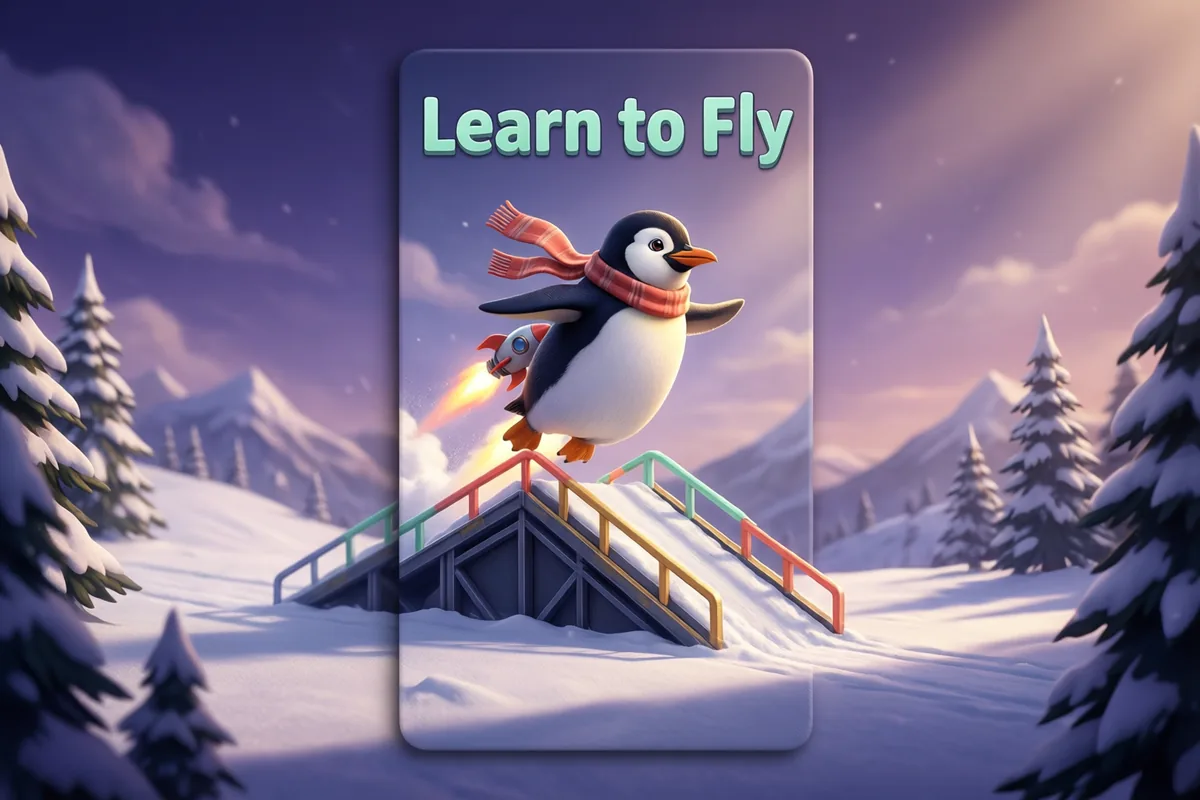 Learn to Fly
Tap upgrades or press 1-4 to buy. Each level of an upgrade costs more than the last, and every upgrade caps at six pips.
Hit LAUNCH to take the ramp. In the air, hold Space (or the BOOST button) to burn rocket fuel for speed and lift.
Up fights the fall and stretches the glide; Down dives for speed. The best flights alternate both like a porpoise.
When the penguin skids to a stop, the day's distance converts to cash for tomorrow's shop. Bounces are part of the trip.
Total distance across all seven flights is your score. Early upgrades compound; day-seven cash buys nothing but regret.
This independent browser adaptation uses the original game’s established title. It is not an official publisher release or an original ROM. Its artwork, tuning and controls may differ from other games with similar rules. Guest personal bests stay in this browser. Signed-in players can also save scores and play history to their private dashboard; there is no global leaderboard. Read about controls and local storage.
Distance is the reward here, but a long flight is not the same as a controlled landing. Try Lunar Lander when you want to practice slowing a craft before touchdown.
Learn to Fly stars a penguin who has read about flying and refuses to accept the ornithological consensus. You get seven launch days to prove the textbooks wrong. Each day starts in the shop, where your winnings buy a taller ramp, sleeker feathers, a stronger booster or a bigger fuel tank; then it is down the ice, off the lip and into the air, where a rocket burn and careful pitch control decide whether you skip across the snow like a stone or carve a line across the whole sky. Cash flows from every meter flown, and the compounding is the real game: a well-spent early day pays for itself three times over by day seven, while a hoarder's penguin stays a pedestrian with dreams. Your score is total distance across all seven flights, so there are no throwaway days, only investments and their consequences. The final flight, fully upgraded, is the payoff every launcher game promises: the moment the ground simply stops being relevant.
| Genre | Browser Skill Games |
|---|---|
| Challenge | Physics plus economics |
| Pace | Seven launches, rising stakes |
| Original era | 2009 (launcher-upgrade era) |
| Players | Single player |
| Controls | Space / BOOST, Up / Down, 1-5 or tap shop |
| Cost | Free, with no account and no download |
The launcher-upgrade genre was the browser era's love letter to compound interest. In the late 2000s a wave of Flash games established the loop: fling something poorly, earn a little cash, buy modest upgrades, fling it slightly less poorly, and repeat until physics surrenders. The most beloved of them starred a flightless bird with a grudge against the dictionary, and its seven-minute arc from tumbling to soaring remains one of casual gaming's most perfect progression curves.
Learn to Fly is our tribute to that loop, compressed to seven decisive days. The physics are honest, the shop math compounds the way the classics taught, and the fixed economy plus deterministic flights mean your distance measures exactly two things: how you spent, and how you flew.
Distance, at just over a dollar per meter, plus a small landing stipend. Every meter of bounce and skid counts toward the total.
They multiply each other, which is the fun. Ramp first is the consensus opening, feathers close behind, and fuel shines from the mid-game onward.
A hard bounce sheds speed but keeps the flight alive; the day ends only when the penguin skids below walking pace. Some of the best distances end in four bounces and a slide.
No. Physics, prices and payouts never change, so the gap between two of your own weeks is pure strategy and stick control.
Clearing 2,000 total meters means you understood compounding; 3,000 means the penguin should be teaching the class.
Four games from the same shelf, each with its own pace. The one-line summaries are how their own pages describe them.
| Game | What it is like | Pace | Play |
|---|---|---|---|
| Jetpac | Some assembly required. Aliens not included but present. | Frantic errands in low gravity | Play |
| Lunar Lander | Feather the throttle, kiss the pad. | Slow, tense, unforgiving | Play |
| Asteroids | Thrust, drift, and blast rocks into gravel. | Momentum-driven - You set the tempo | Play |
Separate anticipation, reaction and continuous steering so you can tell what an attempt actually teaches.
Shortcuts