AsteroidsShooting·Free to play
 Free-Games.toSign inSurprise me
Land the module gently on the flat pads before your fuel tank runs dry.
Independent browser adaptation · Not an official releaseSign in to save your scores and play history, or keep playing as a guest. Recent game activity and scores appear on the homepage with a masked email or IP address.
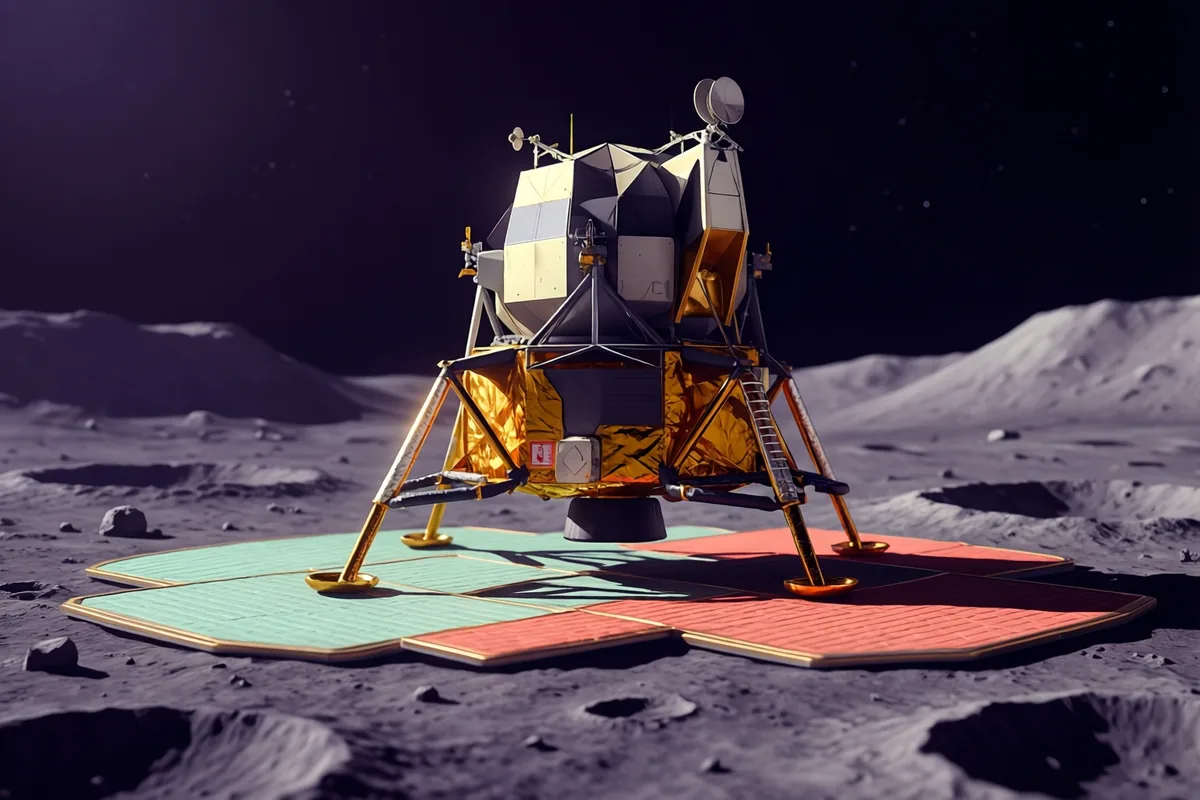 Lunar Lander
Look for the flat pads before you commit to a descent. Wider pads are forgiving; the narrow ones carry score multipliers because they demand a near-perfect approach.
Use the left and right keys to tilt the module. The thruster always pushes opposite the way the module points, so tilting is how you steer sideways and how you cancel drift.
Hold up (or hold a tap) to burn. Short, controlled bursts fight gravity without wasting fuel - A long panicked burn empties the tank and usually overshoots the pad anyway.
A safe landing needs low downward speed, almost no sideways drift, and a nearly upright module. Arrive fast, sideways, or tilted, and the landing becomes a crash.
Every safe touchdown banks points, with multipliers for tough pads. Then the next descent begins with stronger gravity, so each landing is harder than the last.
This independent browser adaptation uses the original game’s established title. It is not an official publisher release or an original ROM. Its artwork, tuning and controls may differ from other games with similar rules. Guest personal bests stay in this browser. Signed-in players can also save scores and play history to their private dashboard; there is no global leaderboard. Read about controls and local storage.
A safe landing spends fuel to control the approach. Learn to Fly instead asks you to turn a launch and boost into distance, then use upgrades between flights.
Lunar Lander hands you a tiny spacecraft, a shrinking fuel tank, and one polite request: please do not hit the Moon very hard. Gravity pulls you down the whole time. Your only answers are rotating the module and firing the thruster, and every burn drinks fuel you will never get back. The flat pads scattered across the jagged terrain are your targets, and the smallest, trickiest pads pay score multipliers to match the risk. Come in slow and level and you touch down like a feather; come in fast or tilted and you become a very expensive crater. Our version keeps the classic rotate-and-thrust physics and turns the gravity up a notch with every safe landing, so no run stays comfortable for long. Play with keys or touch controls, chase the score you set last time, and expect a freshly generated moonscape on every attempt.
| Genre | Arcade Classics |
|---|---|
| Challenge | Physics with consequences |
| Pace | Slow, tense, unforgiving |
| Original era | 1979 (Atari vector cabinet) |
| Players | Single player |
| Controls | ← →, ↑ / Space / Hold tap |
| Cost | Free, with no account and no download |
Lunar Lander is older than almost any arcade game - It started as words on a teletype. In the autumn of 1969, weeks after Apollo 11, high-school student Jim Storer wrote a text-based moon-landing simulation on a PDP-8, where players typed fuel burns and read out their falling altitude line by line. The idea spread through schools and computer labs, and in 1973 Jack Burness built Moonlander, a graphical version for DEC's GT40 vector terminal, complete with a light pen and a mountainous moonscape.
The arcade landmark arrived in August 1979, when Atari released Lunar Lander as its first vector-graphics coin-op. Programmed by Rich Moore, it drew the lander and terrain in crisp glowing lines and gave the cabinet a weighty two-handed thrust lever that let players feather the engine like pilots. It did well, but its own hardware soon overshadowed it: Atari reused the vector display technology months later for Asteroids, one of the biggest hits of the golden age.
The descend-and-land formula never really left. It resurfaced in countless home-computer versions, in Thrust-style cave flyers, and in modern physics games that still grade you on soft touchdowns. The version you are playing brings the 1979 feel to the browser - Same rotate-and-burn physics, same fuel anxiety - With freshly generated terrain and a saved personal best in place of the coin slot.
You need to touch a flat pad slowly, with barely any sideways drift, and with the module close to upright. Miss any of the three and the module breaks up on impact.
The thruster goes silent and gravity finishes the trip. You can still rotate, but with no burn left the best you can hope for is that you were already lined up over a pad.
Pad value scales with difficulty. Narrow pads and pads tucked between peaks carry score multipliers, because reaching them takes extra maneuvering and near-perfect speed control.
Yes. Every successful landing raises the gravity for the next descent, so the same burn buys you less braking each round and your margin for error keeps shrinking.
Loosely, yes - The real Apollo lander also balanced thrust against gravity with a strict fuel budget. The game strips it down to two controls, but the tension is honest physics.
It began as a text-only simulation written in 1969, months after Apollo 11, and became famous as Atari's 1979 vector-graphics arcade cabinet with its glowing mountain skyline.
No. Each attempt generates new terrain and a new pad layout, so you cannot rehearse a descent. The gravity schedule is the constant: it tightens with every safe landing.
Absolutely. Tap the left or right side of the screen to rotate and hold the thrust button to burn - The same short-burst technique works exactly like it does on a keyboard.
Four games from the same shelf, each with its own pace. The one-line summaries are how their own pages describe them.
| Game | What it is like | Pace | Play |
|---|---|---|---|
| Asteroids | Thrust, drift, and blast rocks into gravel. | Momentum-driven - You set the tempo | Play |
| Learn to Fly | Penguins can't fly. This one didn't get the memo. | Seven launches, rising stakes | Play |
| Jetpac | Some assembly required. Aliens not included but present. | Frantic errands in low gravity | Play |
Read the different clocks in Snake, Breakout, Pong and Tetris: grid steps, collisions and falling pieces.
Shortcuts