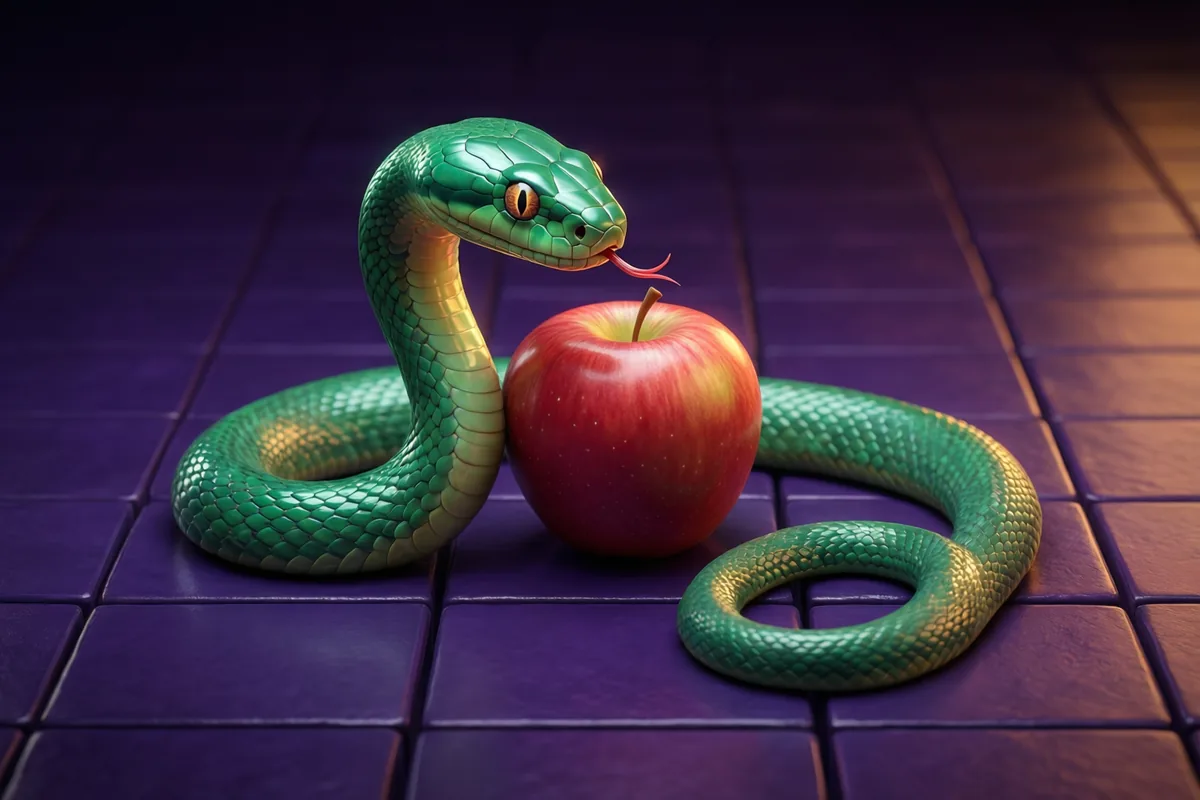
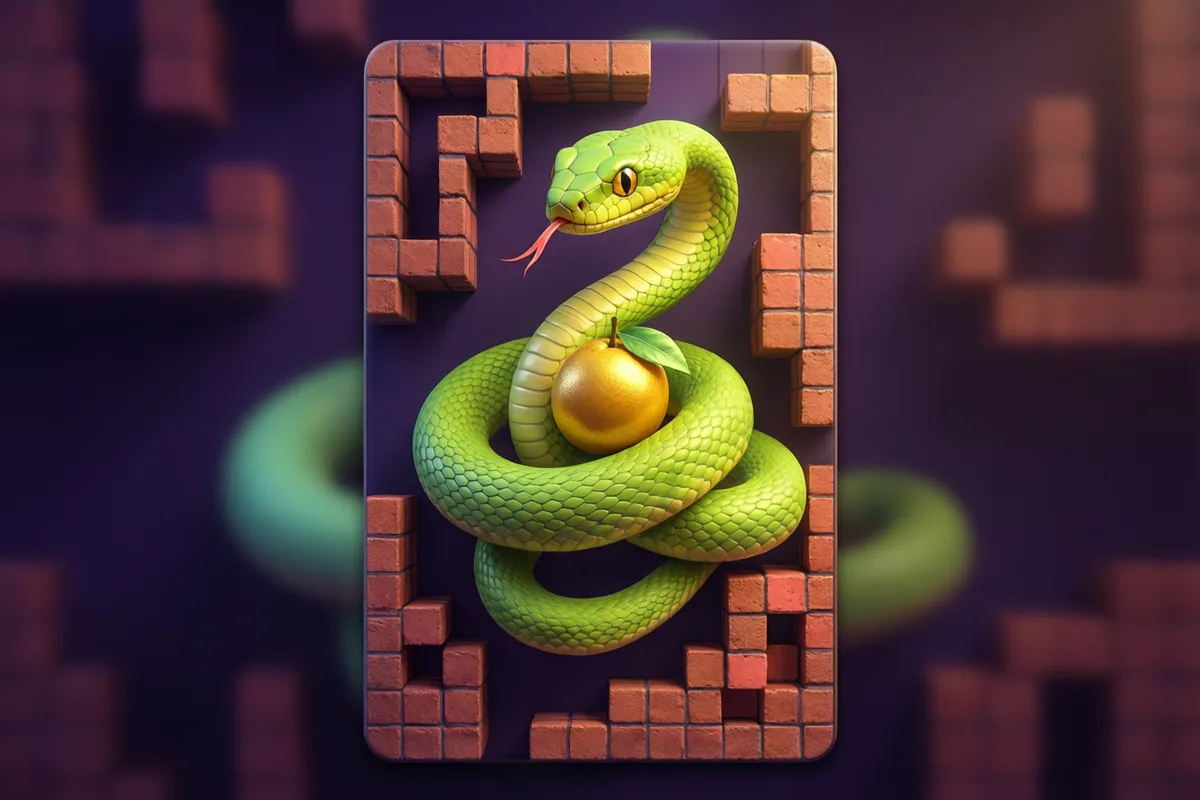
Snake: save some room for the way back.
Keep an open route for your growing body. Look beyond the apple, avoid trapping yourself near a wall, and make turns early enough to preserve room for the next move.
Food changes the space behind your head
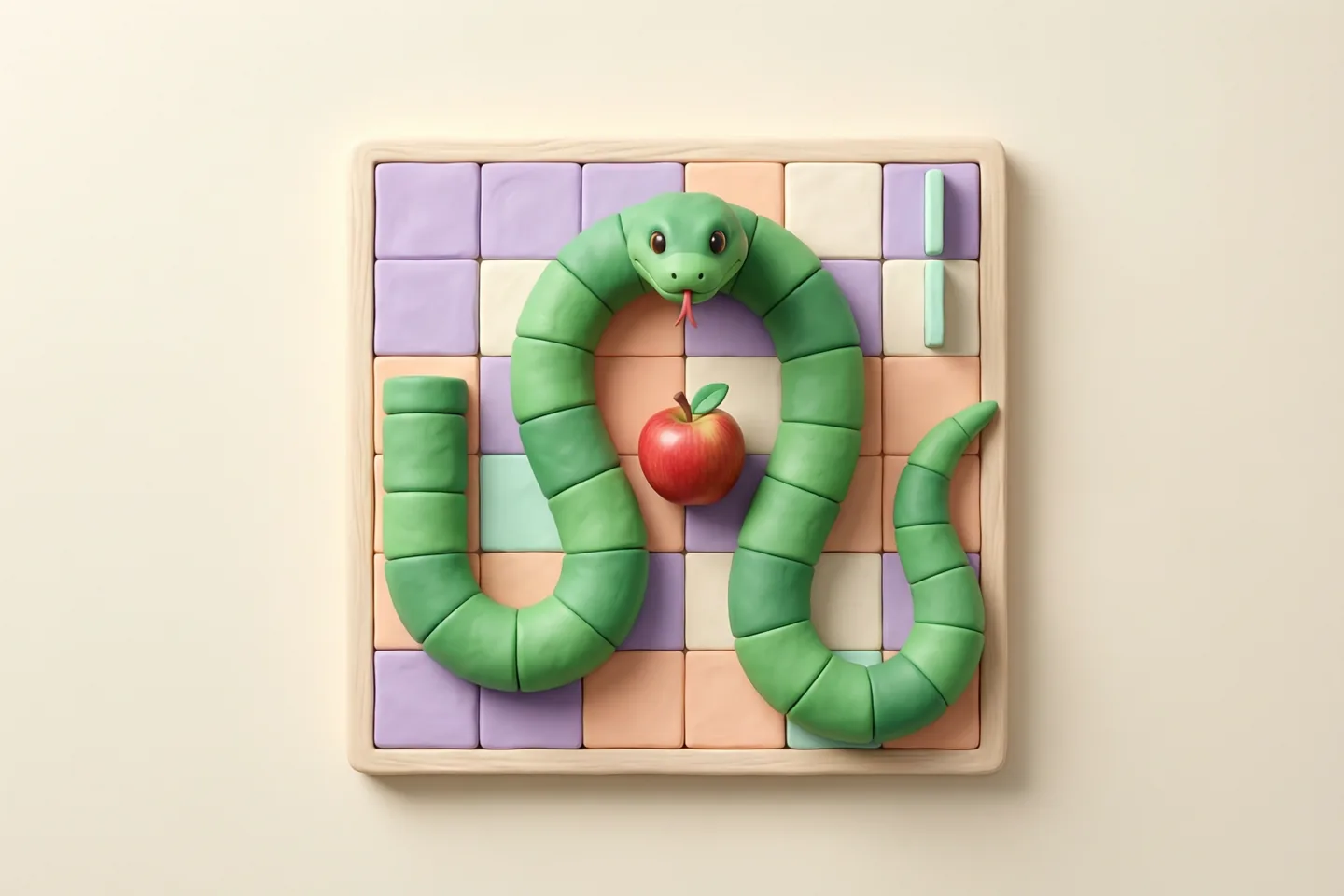
An ordinary Snake step moves the head forward and frees the last tail square. Eating food keeps that square, so the body grows by one.
Routes that rely on the tail moving
A gap that exists only because the tail is about to leave it disappears the moment you eat. Check the food cell and the turn beyond it before committing.
The nearest food is not always the right food
It is a good destination only when the longer body still has a way out afterwards.
Length is the price of every pickup
Each food you eat makes the board one square smaller for the rest of the run. Judge a route by how it looks after that growth rather than before it.
The tail moves too
Your body is not a fixed wall. Every ordinary step frees the square the tail leaves, which is why a corridor that looks blocked can open in time.
Plan the turn after the food
The dangerous moment is not eating; it is the step after eating, when the extra segment is already there. Decide that turn before you take the food.
Use lanes without sealing the exit
Avoid a one-cell pocket with food at the closed end, because your own body can seal the only way in and out.
- You cannot reverse directly into your neck, so a dead end has exactly one exit.
- The move that collects the food can be legal and still leave no legal move afterwards.
- Prefer an open region, or a loop whose exit stays reachable after you grow.
- Broad parallel lanes keep a long body tidy, but a fixed loop is not safe after every pickup.
Count the exits before you enter
A region with one way in and out becomes a trap the moment your body covers that entrance. Two exits give you a second chance after the food adds length.
Leave yourself a second option
Prefer a route that keeps two ways out of the region you are entering. One exit is enough only when you know the tail will clear it in time.
A dead end has exactly one exit
You enter and leave a one-cell pocket through the same square. If your body covers that square when you turn around, the run is over.
Open space is the real score
The number you should watch is how much of the board is still reachable. Food adds to your length; open space is what lets you keep using it.
Queue turns in the order the head will travel
The standard Snake engine accepts a short turn queue. A right-moving head can queue Up and then Left to round a corner over successive steps; asking it to move Left immediately would be a reversal and is ignored. Watch the head complete the first turn before adding unnecessary corrections. This is a grid sequence, so a diagonal swipe or a burst of keys does not create a diagonal move through the corner.
Use a different boundary plan in Snake II
Snake II wraps at the edges, so the boundary rule you learn on the standard board does not carry over.
| Feature | Snake | Snake II |
|---|---|---|
| Board edge | Crossing it ends the run | The head wraps to the opposite side |
| Obstacles | None | Brick obstacles on the board |
| Extras | Food only | Golden bonuses and changing levels |
One habit, two boundaries
Hugging the wall works on the standard board because the wall stops you. In Snake II the same edge sends you straight to the far side, where your own body may be waiting.
Wrapping changes what a wall means
On the standard board the edge is a hazard that ends the run. In Snake II the edge is a door to the opposite side, so check what is waiting there before you use it.
Before wrapping, check the destination edge for your own body or a brick. A wall-following habit needs that extra check.
Compare the same habit on two boards
Open Snake for a playable example from this collection, then continue with the Breakout paddle-angle guide. Browse the arcade classics collection as more games are added to the public library.
Questions about snake
Is it better to circle the edges or use the middle?
Use broad lanes rather than the outer ring. Standard Snake ends the run when the head crosses an edge, so a route hugging the wall gives you no room to correct a late turn. Keep at least one square of space between your body and the boundary while the snake is long.
Why do I crash right after eating food?
Because eating keeps the tail square that a normal step would free, so the body is one square longer than the space you planned for. A pocket that had exactly one exit before the pickup has none afterwards. Check that the exit is still reachable at the new length before you take the food.
Can food appear somewhere I cannot reach?
Yes. Food is placed on any free square, so it can land inside an area your own body has already sealed off. When that happens the run is effectively over, which is the real reason to avoid closing off regions of the board.
Should I move to Snake II when standard Snake feels easy?
Only if you want a different problem, because the boundary rule changes completely. Snake II wraps at the edges, so the head reappears on the opposite side, and it adds brick obstacles and patrol blocks at higher levels. A wall-following habit learned on the standard board becomes a liability there.
These tips refer to the editions in our library. Game controls and behavior can differ elsewhere. Spotted a problem?