Breakout paddle angles: watch the return path.
In this Breakout edition, center contact sends the ball vertically upward. Contact halfway to an edge sends it about thirty degrees from vertical; edge contact reaches about sixty degrees. Position for a safe return before choosing the angle.
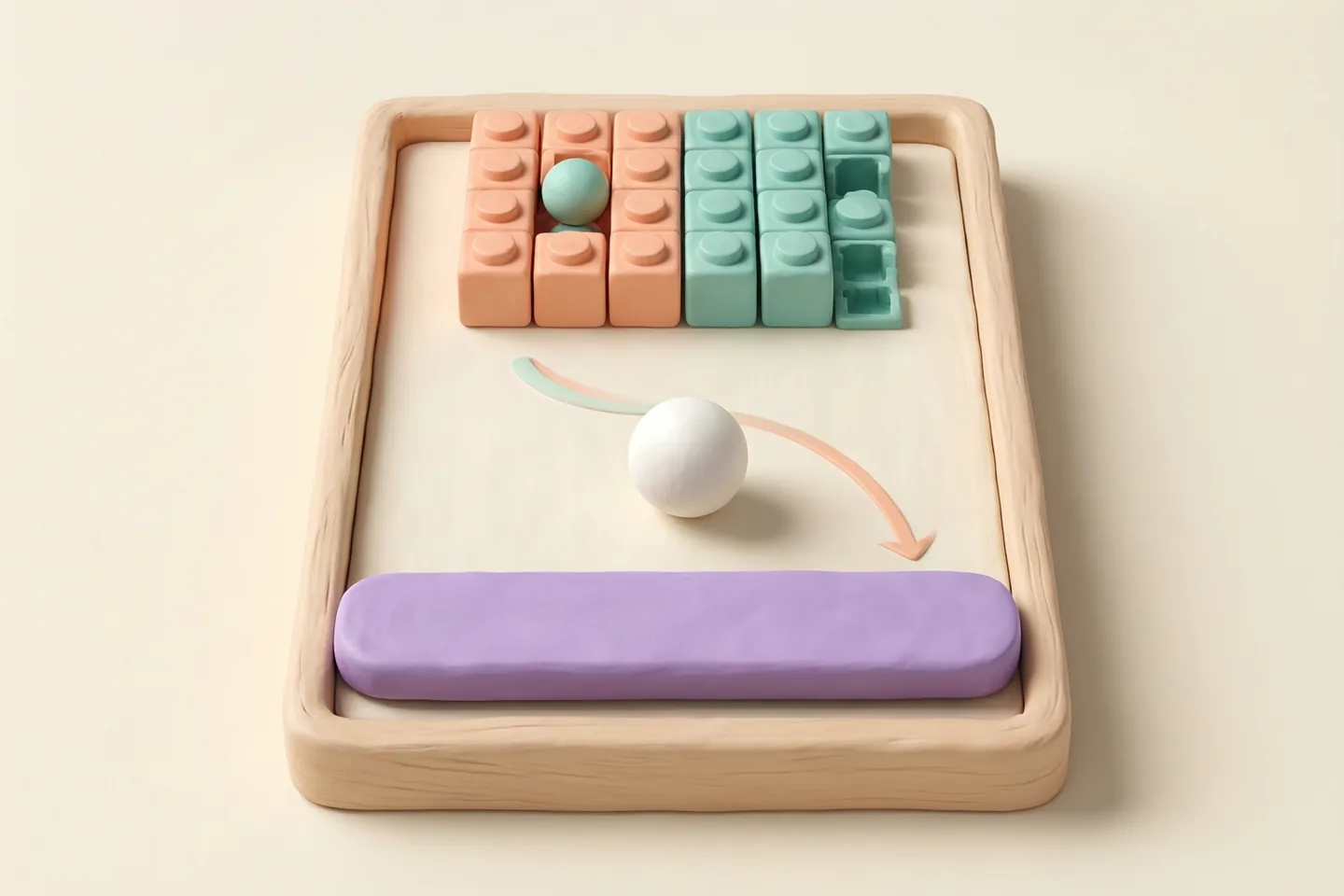
Follow the incoming path to paddle height
Move to the point where the descending ball will meet the paddle, not to the point directly under the ball now.
Reflect the path off the side wall first
If the ball reaches a side wall before paddle height, work out that bounce and follow the new line. Chasing the ball during its upward flight sends you away from the return.
Contact comes before angle
Choose an angle only once enough of the paddle is already under the arriving ball. A miss below the paddle costs one of your three lives.
Predict, then position
Work out the arrival point first and move there once. Following the ball with small corrections leaves you late when it changes direction off a wall.
Speed rises as you play
Paddle returns gradually increase the ball speed, so an arrival you judged correctly a minute ago now comes sooner. Read each return again instead of repeating the previous timing.
Watch the descent, not the climb
The return only matters once the ball is coming down. Use its upward flight to work out where it will land rather than chasing it across the screen.
Wall bounces are predictable
A side wall reflects the ball at the same angle it arrived. Working out that single bounce is usually enough to find the arrival point.
The contact point sets the outgoing angle
Breakout sets the outgoing angle from where the ball contacts the paddle. Center contact sends it straight upward.
| Contact position | Outgoing direction |
|---|---|
| Left edge | 60° left of vertical |
| Halfway from center to left edge | 30° left of vertical |
| Center | Vertically upward |
| Halfway from center to right edge | 30° right of vertical |
| Right edge | 60° right of vertical |
These are positions on the paddle, not percentages of the screen. The rule applies regardless of the incoming horizontal direction. Other paddle games can use a different angle rule.
Trade sideways reach for recovery time
Suppose the ball is arriving just to the right of the paddle center. Moving the paddle slightly right brings the center underneath it and makes the return more vertical. Moving the paddle left puts the contact nearer its right edge and sends the ball farther right. A steeper sideways return can reach an awkward brick, but it also crosses more horizontal distance before coming back. Paddle returns gradually increase speed, so judge the next arrival again rather than relying on the previous timing.
Practice against the actual wall
The Breakout wall is ten columns wide and eight rows deep, so a level means clearing eighty bricks.
| Item | Number | What it means |
|---|---|---|
| Brick columns | 10 | The width of the wall |
| Brick rows | 8 | The top rows are worth more points |
| Bricks in a level | 80 | Clearing them all builds the next level |
| Starting lives | 3 | A miss below the paddle costs one |
Practise on the live wall
Keep one ball alive and alternate deliberate centre contacts with offset ones. Eighty bricks give you plenty of returns to compare before the level ends.
Eighty bricks, three lives
A level gives you plenty of returns to experiment with, but only three misses. Spend the early bricks learning the contact points while the wall is still dense.
Compare contacts deliberately
Alternate a few centre hits with a few offset ones and watch where each return goes. Two or three comparisons teach the paddle rule faster than one long careful run.
Do not carry the rule across to Pong
Pong also changes its return by contact point, but its paddle is vertical and its angle rule is its own. Learn the two games separately.
Use the offset return for awkward bricks
A contact away from the centre sends the ball further sideways, which is how you reach a brick in a corner. It also crosses more of the screen before it comes back.
Compare a few centre contacts with deliberately offset ones while keeping the ball alive. Pong also changes a return by contact point, but it uses a vertical paddle and its own angle rule.
Watch a real paddle contact
Open Snake for a playable example from this collection, then continue with the Mini Putt aiming guide. Browse the arcade classics collection as more games are added to the public library.
Questions about breakout paddle angles
Why does the ball keep coming back to the same side?
Because you are meeting it with the same part of the paddle each time. The contact point sets the outgoing angle, so a ball caught halfway between the centre and the left edge leaves at about thirty degrees left of vertical every time. Move a little further under the ball to flatten the return.
Should I chase the ball or wait for it?
Move to where it will meet paddle height, then stop and wait there. Chasing the ball's current position keeps you arriving late and catching it on the wrong part of the paddle. Following the descending path down to your own row is the whole skill.
Does the ball really get faster?
Yes. Paddle returns gradually increase the ball speed within a level, so a timing that worked on the first few returns will be early later on. Judge each arrival fresh rather than repeating the last rhythm.
How do I clear the top rows without losing the ball?
Open a channel up one side and let the ball work above the wall rather than aiming individual shots at the top. An edge contact sends the ball out about sixty degrees from vertical, which is what carries it sideways into a gap. The steeper the return, the further it travels before it comes back to you.
What do the falling capsules do?
They change the paddle or the ball rather than the wall. One widens the paddle for a while, one adds a life up to a maximum of six, and others arm the paddle or add balls. Catching one is worth a small risk, but not a return you would otherwise reach comfortably.
These tips refer to the editions in our library. Game controls and behavior can differ elsewhere. Spotted a problem?