ColumnsPuzzle·Free to play
 Free-Games.toSign inSurprise me
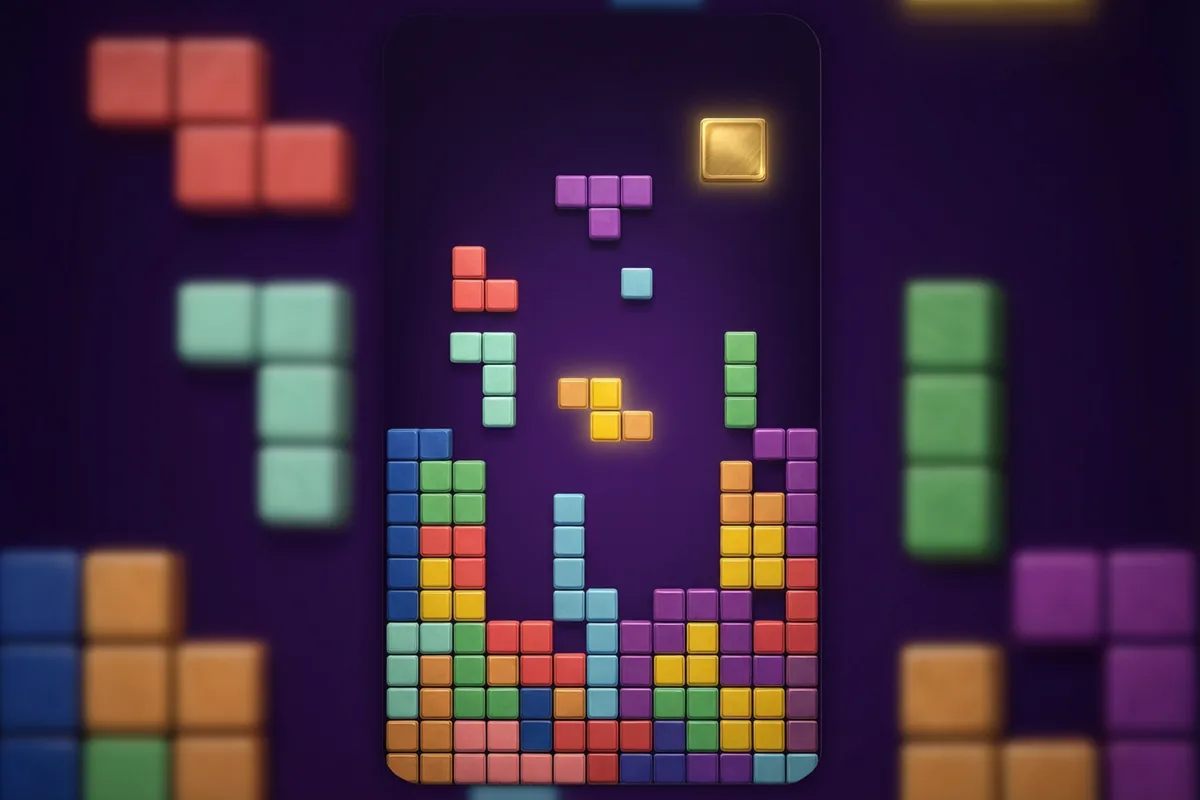
Rotate and place falling tetrominoes to complete and clear full rows.
Independent browser adaptation · Not an official releaseSign in to save your scores and play history, or keep playing as a guest. Recent game activity and scores appear on the homepage with a masked email or IP address.
 Tetris
Each of the seven shapes suits a different gap. Decide where the new piece belongs the instant it enters the well - At higher speeds there is no time to decide on the way down.
Use the left and right arrows to slide the piece and the up arrow or X to rotate it. Every piece can be turned and steered right up until the moment it locks into the stack.
Holding the down arrow speeds the fall while you keep full control. Space slams the piece straight down instantly - Faster and worth points, but there is no changing your mind.
A row disappears the moment every cell in it is filled, and the stack above settles down. Clear two, three, or four rows with one piece and the points multiply sharply.
Clearing lines raises your level, and every level makes pieces fall faster. The run ends when the stack climbs to the top of the well and a new piece has nowhere to spawn.
This independent browser adaptation uses the original game’s established title. It is not an official publisher release or an original ROM. Its artwork, tuning and controls may differ from other games with similar rules. Guest personal bests stay in this browser. Signed-in players can also save scores and play history to their private dashboard; there is no global leaderboard. Read about controls and local storage.
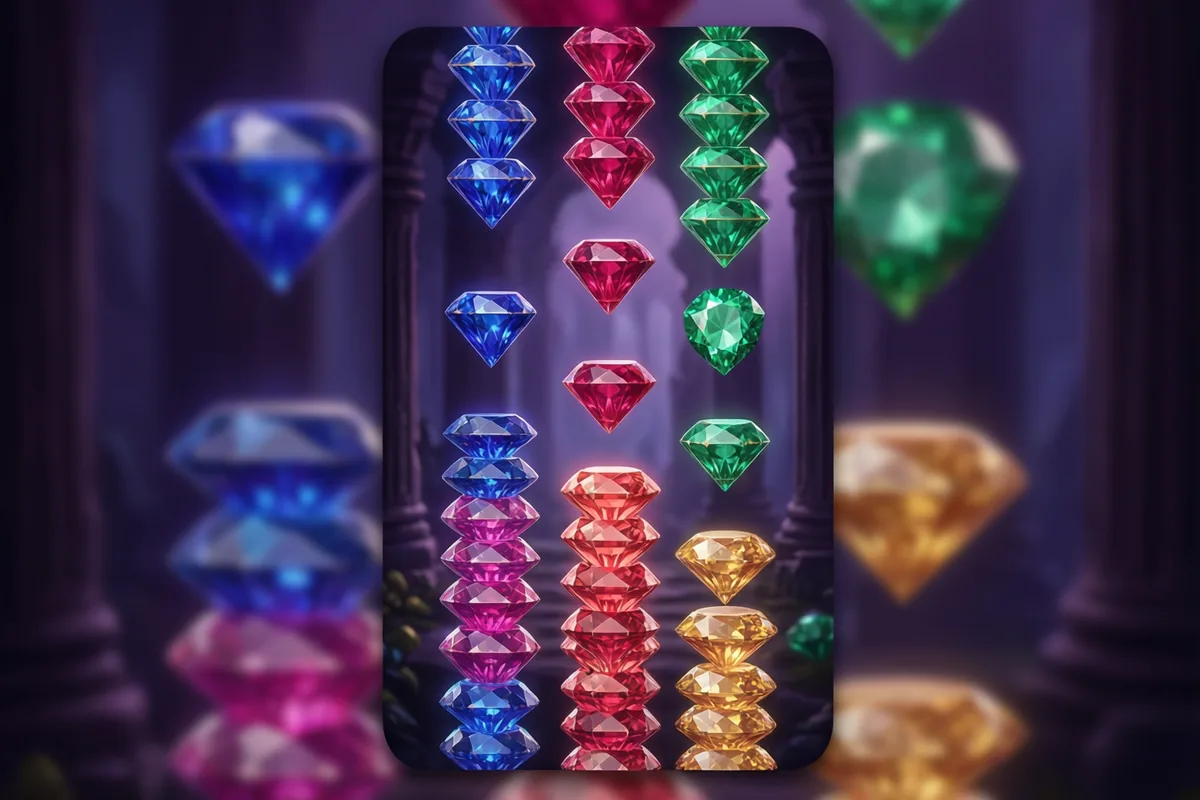
Leaving room for a falling piece matters more than filling every gap immediately. Columns changes the task from complete rows to matching gems, with columns whose order you can rotate.
Tetris is the falling-shape puzzle your brain refuses to put down. Seven different pieces tumble into the well one at a time, and your job is to shift them, spin them, and slot them into solid rows. Complete a row and it vanishes; complete several with a single piece and the score multiplies fast - Clearing four lines at once is the whole reason your stack has a bottom corner reserved. Nothing chases you here except gravity: every level drops the pieces quicker, until careful planning melts into pure instinct. Our version gives you sharp keyboard control with soft drops for steering and hard drops for commitment, touch controls tuned for thumbs, and scoring that always pays more for bravery than for tidiness. Every run deals a brand new sequence of pieces, so the luck is never the same twice and the only score worth beating is the one you set last time.
| Genre | Arcade Classics |
|---|---|
| Challenge | Easy rules, endless depth |
| Pace | Levels raise the drop speed |
| Original era | 1984 (Elektronika 60) |
| Players | Single player |
| Controls | ← → / ↓, ↑ / X, Space, 1 / HOLD, Swipe (mobile) |
| Cost | Free, with no account and no download |
In June 1984, Alexey Pajitnov, a researcher at the Computing Center of the Soviet Academy of Sciences in Moscow, wrote a small puzzle game on an Elektronika 60 - A terminal with no graphics at all, so the falling shapes were drawn from bracket characters. He called it Tetris, blending tetra, for the four squares in every piece, with tennis, his favorite sport. Colleagues could not stop playing, and a teenage programmer named Vadim Gerasimov soon ported it to the IBM PC, which let copies slip across the Iron Curtain on floppy disks.
What followed was one of gaming's wildest rights battles, with publishers on three continents claiming pieces of a game owned, technically, by the Soviet state. Dutch-born entrepreneur Henk Rogers untangled it in Moscow in 1989, securing handheld rights for Nintendo - And the game shipped inside the box with the original Game Boy, selling tens of millions and making the falling-block puzzle a permanent piece of human culture.
Tetris is our tribute to that lineage: seven pieces, one well, gravity forever. The rules that hypnotized a Moscow computing lab in 1984 turn out to work exactly as well in a browser tab in the 2020s, on a phone in a waiting room, or anywhere else a spare three minutes needs filling.
Score as many points as you can by clearing complete rows before the stack reaches the top of the well. There is no final level - The game always ends, and the score is the story.
Risk pays. Setting up a double, triple, or four-line clear means letting your stack grow taller and more dangerous first, so the game rewards the gamble with steeply multiplied points.
Soft drop (down arrow) speeds the piece's fall while you can still slide and rotate it. Hard drop (Space) teleports it straight down and locks it instantly - Quicker, but final.
When the stack gets so tall that a new piece has no room to enter the well. Nothing else stops you - There is no timer and no enemy, just gravity and your own architecture.
Each level raises the drop speed. Early levels give you time to plan every placement; late levels fall so fast that your hands have to know the answer before your eyes finish asking.
It was invented in a Moscow computer lab in 1984 and went on to become one of the best-selling games ever made. The full story is in the history section below.
No. Every run shuffles a fresh piece sequence, so you cannot rehearse an opening. What carries over is your habit of keeping the stack flat and one column clear.
Touch controls are built in: tap to rotate, swipe sideways to move the piece, swipe down to drop. It runs in your mobile browser with nothing to download or install.
Four games from the same shelf, each with its own pace. The one-line summaries are how their own pages describe them.
| Game | What it is like | Pace | Play |
|---|---|---|---|
| Columns | Three gems fall as one - Line up any three that match. | Columns fall faster per level | Play |
| Pipe Mania | The goo is coming. Your plumbing isn't ready. | Shorter countdowns, faster goo | Play |
| Sudoku | Fill each row, column and 3 × 3 box with the digits 1–9. | As slow as you like, no timer pressure | Play |
Read the different clocks in Snake, Breakout, Pong and Tetris: grid steps, collisions and falling pieces.
Shortcuts