
Balloon PopSkill·Free to play
 Free-Games.toSign inSurprise me
Wait for the signal, then react faster than the machine across ten duels and a sudden-death tiebreak.
Sign in to save your scores and play history, or keep playing as a guest. Recent game activity and scores appear on the homepage with a masked email or IP address.
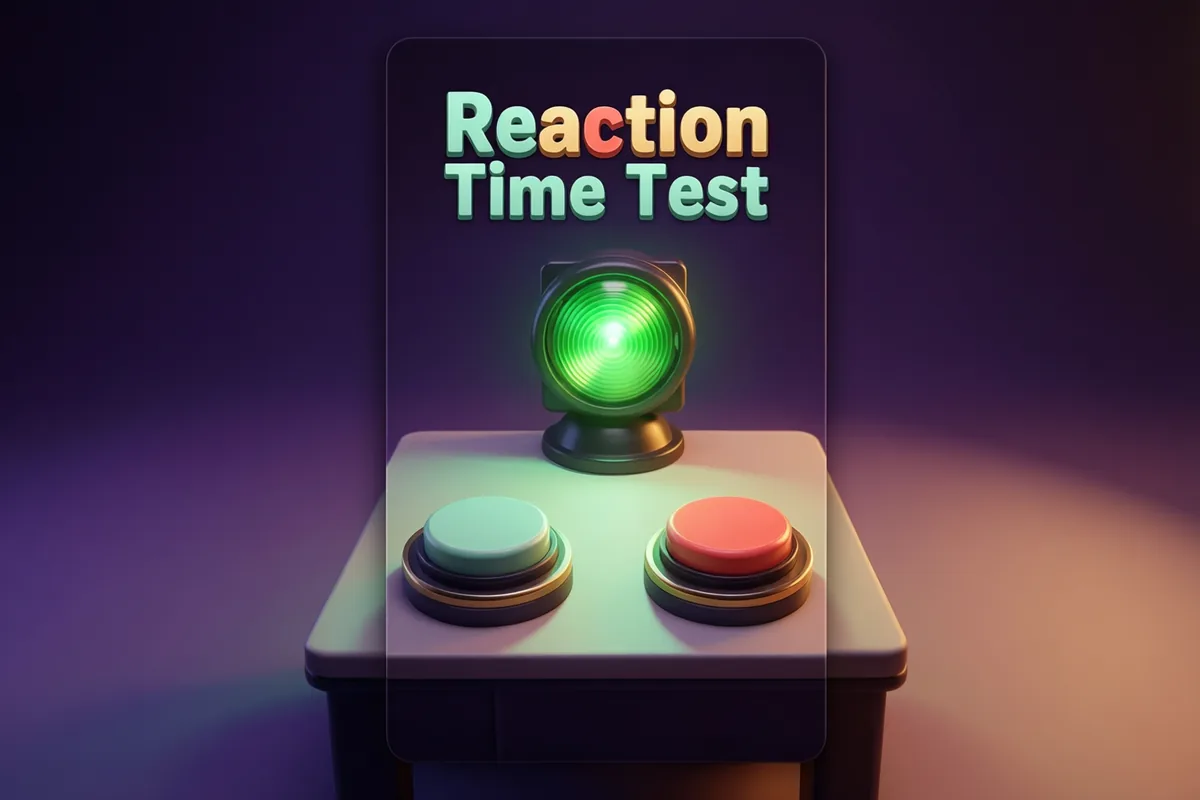 Reaction Time Test
Every duel starts with a wait screen. Rest your finger on the spacebar or the screen and go still - The signal arrives after a delay designed to punish guessers.
Nothing that happens before the signal matters. Hold your nerve through the pause; the duel only begins the instant the signal fires.
Press Space or tap as fast as you can. Your reaction is clocked in milliseconds and lined up against the machine's draw for that round.
Press before the signal and the false-start rule hands the round to the AI instantly. A fast loss is still a loss.
The duel runs ten rounds (sudden death breaks a tie), and the AI's draw gets tighter in every one. Take more rounds than the machine - Your times are what your best average remembers.
This is our browser edition, adapted from ARCADENOW. Its artwork, tuning and controls may differ from other games with similar rules. Guest personal bests stay in this browser. Signed-in players can also save scores and play history to their private dashboard; there is no global leaderboard. Read about controls and local storage.
Reacting early is different from reacting accurately. In Fruit Ninja, you also have to track the object and avoid bombs, so pointer placement matters alongside response time.
Reaction Time Test strips arcade gaming down to its rawest ingredient: the gap between seeing and doing. Ten rounds, plus sudden death if it ends level. One signal. Whoever draws faster takes the round - And your opponent is a machine that gets a little quicker every time you beat it. The rules are old-west simple: wait for the signal, then hit as fast as your nerves allow. Twitch early and the false-start rule hands the round away, so guessing is a losing religion here. Every draw is scored in milliseconds, so you learn exactly what your hands are worth - Most humans live around 250 ms, and a personal best usually lives well under it. The AI tightens across all ten rounds, turning the final duels into genuine photo finishes. Play with the spacebar or a tap, chase your average down, and expect a fresh set of signal delays every duel, because guessing the wait is not a skill worth having.
| Genre | Browser Skill Games |
|---|---|
| Challenge | Milliseconds decide everything |
| Pace | False starts cost you the round |
| Original era | Reaction-tester cabinets |
| Players | Single player |
| Controls | Space / Tap |
| Cost | Free, with no account and no download |
Long before video games, penny arcades sold reaction and nerve as entertainment. From the late 1800s, electro-mechanical testers lined boardwalks and amusement piers: grip machines that scored your squeeze, love testers that graded your spark, strength hammers that rang a bell if you earned it. The pitch never changed - Drop a coin, get a number, argue about it with your friends.
The quick-draw fantasy gave that number a villain. In 1975 Midway released Gun Fight, an American adaptation of Taito's Western Gun by designer Tomohiro Nishikado - Two cowboys, two players, and the first arcade video game built around a microprocessor, the Intel 8080. Suddenly a machine could referee a duel to the split second, and reaction time became one of gaming's core currencies, from light-gun showdowns to whack-a-mole cabinets.
Reaction Time Test distills that whole lineage to its essence: no bullets, no gimmicks, just you against a clock and an opponent that never blinks. Your browser now times a draw more precisely than any boardwalk machine ever could, and every duel gives you ten fresh rounds to sweat through.
Ten rounds. In each one, you and the AI wait for the same signal, and whoever reacts faster takes the round. Win more rounds than the machine to win the match.
Any press before the signal fires. The round goes to the machine immediately, no do-overs - Without that rule, blind spamming would beat genuine skill.
Most people land between 200 and 300 milliseconds on a visual signal. Anything under 200 is genuinely quick, and the sharpest duelists push toward the 170s.
Yes. Its draw tightens round by round across the match, so early leads matter - The final rounds are where even great reflexes start losing coin flips.
Yes. Each round rolls a fresh delay, so you cannot time it by rhythm or count in your head. The only winning move is honest reaction.
It can. Modern browsers expose high-resolution timers, and the game clocks your input against the frame the signal appeared - Accurate enough to separate a 210 from a 230.
No. Each duel rolls new signal delays, which is what stops anticipation from working - Your average measures nothing but nerves.
Absolutely. Tap anywhere on the play area to draw. Rest your thumb lightly on the glass while you wait, so the moment of contact is all reaction and no reach.
Four games from the same shelf, each with its own pace. The one-line summaries are how their own pages describe them.
| Game | What it is like | Pace | Play |
|---|---|---|---|
| Balloon Pop | Pop the fleet before it floats out of reach. | Balloons rise faster in every wave | Play |
| Fruit Ninja | Swipe fast, slice clean, never touch the bombs. | Fruit storms grow denser | Play |
| Piano Tiles | Four lanes of falling keys - Miss one and the music stops. | BPM climbs with your score | Play |
| Claw Crane | The claw is honest here - Your timing isn't. | Prizes shrink, claw swings faster | Play |
Separate anticipation, reaction and continuous steering so you can tell what an attempt actually teaches.



Shortcuts